
Dragonfly
Credit: Wikimedia Commons · CC BY-SA 3.0
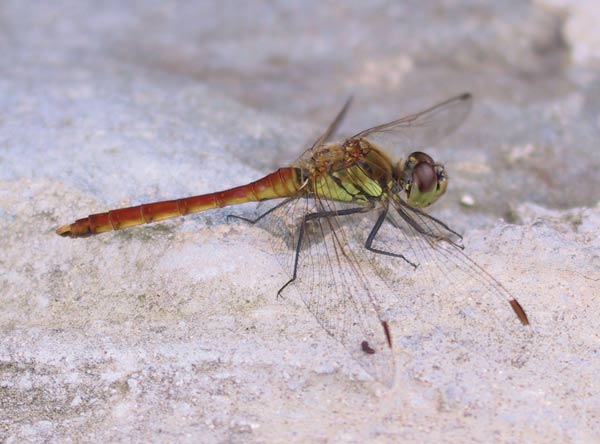
A dragonfly is a flying insect with a long, thin body and four see-through wings. Dragonflies are found near ponds, lakes, rivers, and wetlands on every continent except Antarctica. There are about 3,000 different kinds. They are some of the fastest and most skilled fliers in the animal world.
A dragonfly has three main body parts: a head, a chest called the thorax, and a long abdomen. Its four wings can move on their own, unlike most insects, whose wings move together. The front pair and the back pair can flap at different speeds and in different directions. This is why dragonflies can hover in place, fly backward, and turn in a flash.
Dragonflies are skilled hunters. They eat mosquitoes, flies, gnats, and even other dragonflies. They catch prey in midair using their spiny legs, which fold into a basket shape. Scientists have studied how often dragonflies catch what they chase. The answer is about 95 percent of the time. That makes the dragonfly one of the most successful hunters of any animal on Earth. Lions, by comparison, catch prey only about 25 percent of the time.
A dragonfly's eyes take up most of its head. Each eye has up to 30,000 tiny lenses. This gives the dragonfly almost 360-degree vision. It can see in front, behind, above, and below at the same time. Dragonflies can also see colors that humans cannot, including some kinds of ultraviolet light.
A dragonfly's life starts in the water. A female lays her eggs on plants or in the mud of a pond. The eggs hatch into young called nymphs. A nymph does not have wings. It lives underwater, sometimes for years, breathing through gills. Nymphs are fierce hunters too. They eat tadpoles, small fish, and water insects. When a nymph is ready to become an adult, it climbs out of the water on a plant stem. Its skin splits open, and the adult dragonfly crawls out and spreads its wings.
Dragonflies are very old. Fossils show that their relatives were flying 300 million years ago, long before dinosaurs. Some ancient dragonflies had wingspans of more than two feet, wider than a large pizza. Scientists think the air back then had more oxygen, which let insects grow much bigger than they can today.
Today's dragonflies are much smaller, but just as amazing to watch. The next time you pass a pond in summer, look closely above the water. A dragonfly is probably there, hunting.
Related
Last updated 2026-04-22