
World War I
Credit: User:Hohum · Public domain
World War I was a huge war fought mostly in Europe from 1914 to 1918. People at the time called it the Great War, because no war that big had ever happened before. More than 30 countries took part. About 20 million people died, and another 21 million were wounded. It was one of the deadliest wars in human history.
How it started
By 1914, the powerful countries of Europe had split into two groups. On one side were the Allied Powers, led by France, Russia, and Great Britain. On the other side were the Central Powers, led by Germany and Austria-Hungary. Each group had promised to defend its friends if anyone attacked them.
The spark came on June 28, 1914. A young man from Serbia shot and killed Archduke Franz Ferdinand, the heir to the throne of Austria-Hungary, in the city of Sarajevo. Austria-Hungary blamed Serbia and declared war. Then the promises kicked in. Russia stood up for Serbia. Germany stood up for Austria-Hungary. France and Britain joined Russia. Within weeks, most of Europe was at war. Later, the Ottoman Empire joined the Central Powers, and many other countries joined the Allies.
Historians still debate exactly who deserves the most blame. Some point to Germany's leaders, who pushed for war. Others say all the major powers shared the blame for building up huge armies and tangled alliances.
Trench warfare
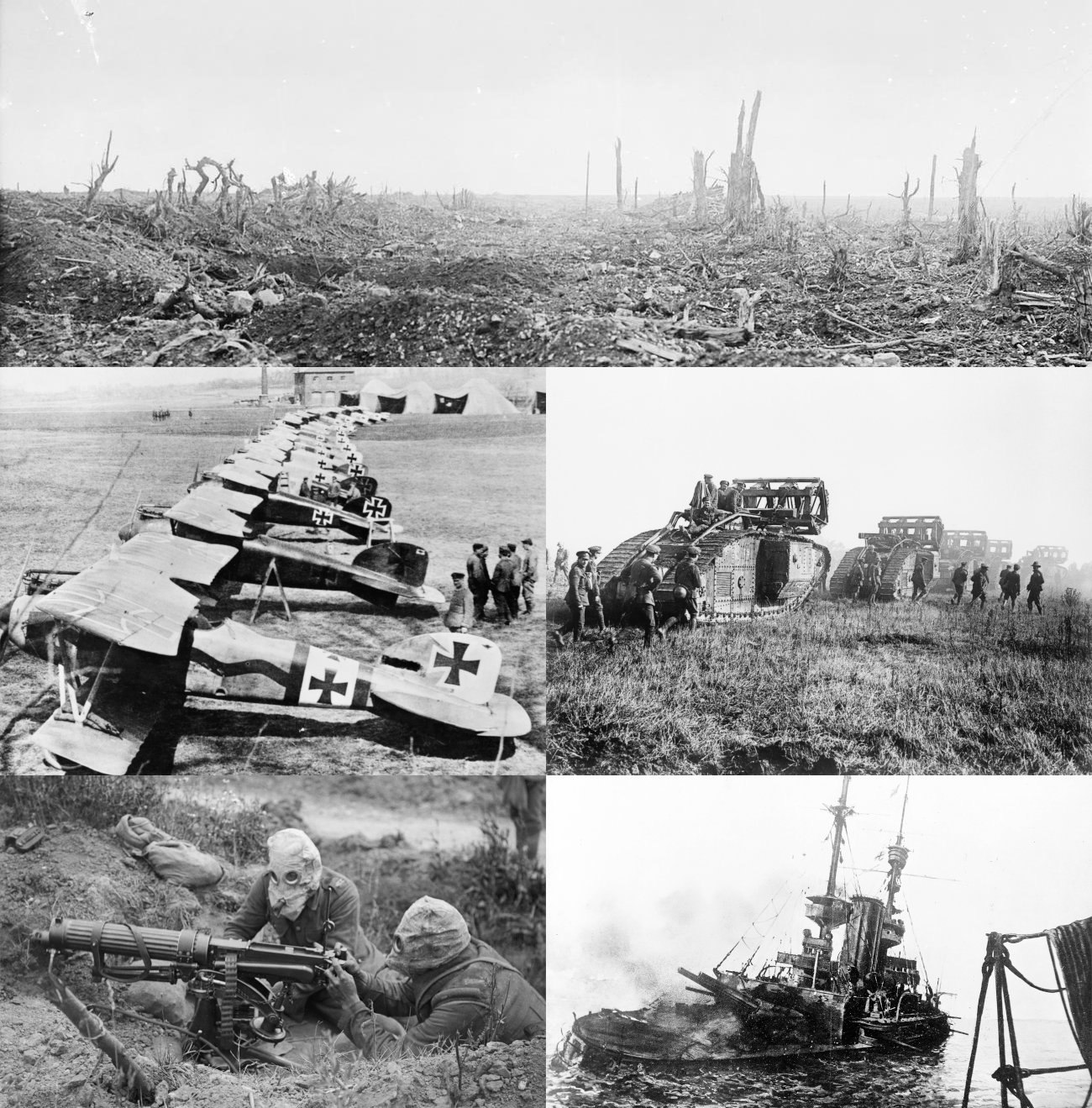
Most of the fighting in the west happened along a long line of ditches called trenches. The trenches stretched about 475 miles from the coast of Belgium down to Switzerland. Soldiers dug them deep into the ground to hide from bullets and shells. The strip of muddy land between the two sides was called "no man's land."
Life in the trenches was miserable. Soldiers stood in cold water for days. Rats and lice crawled everywhere. Diseases like trench foot rotted men's feet inside their boots. When officers ordered an attack, soldiers climbed up out of the trench and ran across no man's land into machine gun fire. Battles often went on for months and moved the line only a few miles. The Battle of the Somme in 1916 lasted four and a half months and killed or wounded more than a million men.
New weapons
World War I changed the way wars were fought. Both sides used weapons that had never been used at this scale before. Machine guns could fire 600 bullets a minute. Big artillery guns could hit targets miles away. Poison gas was used for the first time, blinding and choking soldiers in the trenches. Tanks rolled across no man's land and crushed barbed wire. Airplanes, which had only been invented eleven years before the war, were used to spy on the enemy and to drop bombs. Submarines, called U-boats by the Germans, sank ships in the Atlantic Ocean.
These new weapons killed more soldiers, and faster, than any older weapons could. That is a big reason the death toll was so high.
The United States enters
At the start of the war, the United States stayed out. Most Americans wanted nothing to do with Europe's fight. But German submarines kept sinking ships, including ships carrying American passengers. In 1915 a U-boat sank the British ship Lusitania, killing 128 Americans. In early 1917, the United States learned that Germany had secretly asked Mexico to attack America. That was the final push. The United States declared war on Germany in April 1917 and sent more than two million soldiers to Europe.
The war ends
By 1918, the Central Powers were running out of food, soldiers, and supplies. American troops gave the Allies fresh strength. Germany's allies surrendered one by one. On November 11, 1918, at 11 a.m., Germany signed an agreement to stop fighting. The day is still remembered every year. In the United States it is called Veterans Day, and in many other countries it is called Remembrance Day.
What came after
The leaders of the Allied countries met in France in 1919 and wrote the Treaty of Versailles. The treaty forced Germany to give up land, shrink its army, and pay huge sums of money for war damage. Many Germans felt the treaty was unfair and cruel. Their anger helped a man named Adolf Hitler rise to power in the 1930s. Hitler started World War II only 21 years after World War I ended.
People had hoped the Great War would be "the war to end all wars." It was not. But it did change the world. Four old empires collapsed. New countries appeared on the map. And every November, poppies are still worn to remember the soldiers who never came home.
Related
Last updated 2026-04-26