
Bronze Age
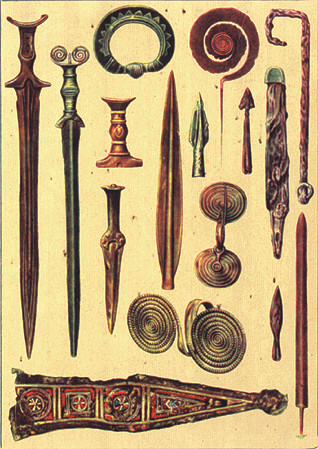
Credit: Work of Romanian goverment · Public domain
The Bronze Age was a period in human history when people began making tools and weapons out of bronze. It started around 3300 BCE in parts of the Middle East and lasted until about 1200 BCE in most regions. The Bronze Age came after the Stone Age and before the Iron Age. It was the first time humans worked with metal on a large scale.
Bronze is not a metal that is found in the ground. It is a mixture, also called an alloy. To make bronze, smiths melted copper and mixed in a smaller amount of tin. The result was much harder than copper alone. Bronze tools held a sharp edge longer, and bronze weapons were stronger than anything made from stone.
This change reshaped daily life. Farmers could plow tougher soil with bronze blades. Builders could shape stone and wood with better tools. Soldiers carried bronze swords, spears, and shields into battle. Cities grew larger because farmers could now feed more people, and rulers grew more powerful because their armies were better armed.
The Bronze Age was also when many of the first great civilizations rose. Ancient Egypt built its pyramids during this time. In Mesopotamia, the Sumerians invented writing on clay tablets around 3200 BCE. Other Bronze Age cultures included the Minoans on the island of Crete, the Mycenaeans in Greece, the Hittites in what is now Turkey, and the Shang dynasty in China. Trade routes stretched for thousands of miles, partly because tin was rare and had to be shipped long distances to make bronze.
Then, around 1200 BCE, something went very wrong. Across the eastern Mediterranean, city after city was burned or abandoned. The Mycenaean kingdoms collapsed. The Hittite empire fell apart. Egypt was attacked by mysterious raiders the Egyptians called the "Sea Peoples." Trade routes broke down. In some regions, writing itself was lost for hundreds of years.
Historians call this the Bronze Age Collapse, and they still argue about what caused it. Some blame a long drought that ruined harvests. Some point to powerful earthquakes that shook the region. Others think invaders, civil wars, or the failure of trade networks brought everything down. Most experts now think it was several disasters happening at once, with each one making the others worse.
After the collapse, people slowly began using a new metal: iron. Iron ore was easier to find than tin, and iron tools were even stronger than bronze. The Iron Age had begun. But the foundations laid during the Bronze Age, including writing, cities, and long-distance trade, never really went away.
Related
Last updated 2026-04-26