
United States Presidents
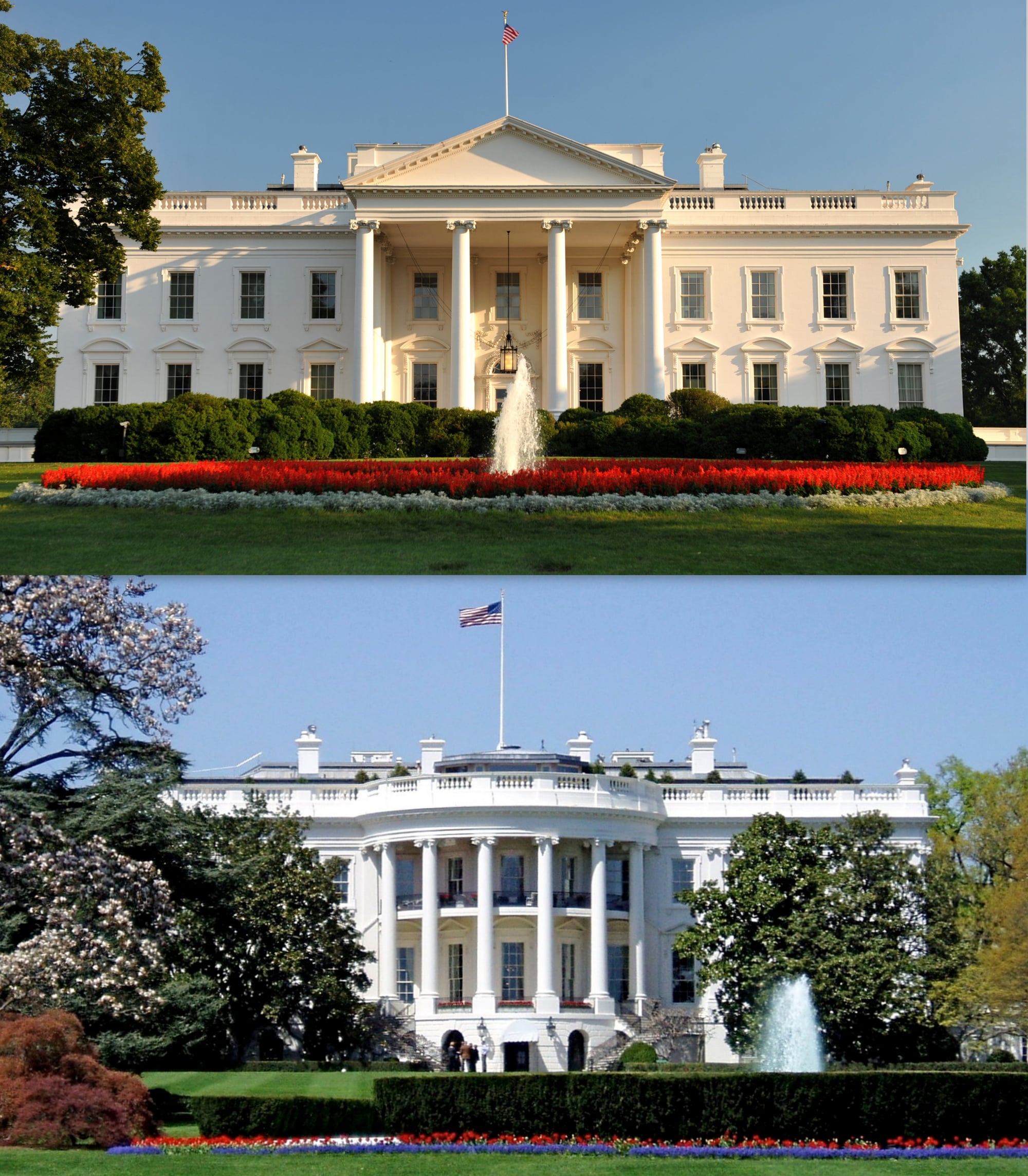
Credit: (top)Cezary p(bottom)MattWade · CC BY-SA 4.0
The United States President is the leader of the United States government and the head of the country. The President lives and works in the White House in Washington, D.C. The job was created by the U.S. Constitution in 1789. Since then, 45 different people have served as President.
The President has many jobs. He or she signs new laws passed by Congress, or vetoes them, which means saying no. The President leads the military as commander in chief. The President meets with leaders from other countries and chooses judges for the Supreme Court. The President also picks people to run large parts of the government, like the Department of Education and the Department of Defense.
To become President, a person must be at least 35 years old, born a U.S. citizen, and have lived in the country for 14 years. Voters across the country choose the President every four years. A President can only be elected twice, for a total of eight years. This rule was added in 1951, after Franklin D. Roosevelt was elected four times in a row.
Two Presidents, Grover Cleveland and Donald Trump, served two terms that were not in a row. That is why some Presidents are listed twice in the official numbering. There have been 47 presidencies, but only 45 different people who held the job.
All 45 Presidents
The Founders (1789 to 1829)
1. George Washington (1789 to 1797). Washington led the army that won independence from Britain. As President, he set the tradition of stepping down after two terms. He is often called the father of his country.
2. John Adams (1797 to 1801). Adams helped write the Declaration of Independence. As President, he kept the country out of war with France. He also signed the Alien and Sedition Acts, which let the government jail people for criticizing it. Those laws are seen today as one of the worst attacks on free speech in American history.
3. Thomas Jefferson (1801 to 1809). Jefferson wrote the Declaration of Independence. As President, he doubled the size of the country by buying the Louisiana Territory from France. He also enslaved more than 600 people during his life, and historians today wrestle with how a man who wrote "all men are created equal" could keep families enslaved.
4. James Madison (1809 to 1817). Madison is called the "Father of the Constitution" because he wrote much of it. He led the country through the War of 1812 against Britain. The British burned the White House during that war, and Madison's wife Dolley saved a famous painting of George Washington before fleeing.
5. James Monroe (1817 to 1825). Monroe was the last President who had fought in the American Revolution. He created the Monroe Doctrine, which warned European countries to stay out of the Americas. His time in office was so peaceful it was called the "Era of Good Feelings."
6. John Quincy Adams (1825 to 1829). The son of John Adams, he was the first child of a President to also become President. He was a strong opponent of slavery. After leaving office, he served in Congress for almost twenty more years.
Westward Push and the Road to Civil War (1829 to 1861)
7. Andrew Jackson (1829 to 1837). Jackson was the first President from a poor frontier family, and his supporters saw him as a hero of the common man. He also signed the Indian Removal Act, which forced tens of thousands of Native Americans off their lands. Thousands died on the journey west, called the Trail of Tears. Most historians today see this as one of the darkest chapters in American history.
8. Martin Van Buren (1837 to 1841). Van Buren took office just as a huge financial crash hit the country, called the Panic of 1837. Many banks closed and millions of people lost their jobs. He was not elected to a second term.
9. William Henry Harrison (1841). Harrison gave the longest inaugural speech in history, almost two hours long, on a cold rainy day. He died of an illness only 31 days later. His term remains the shortest of any President.
10. John Tyler (1841 to 1845). Tyler was the first Vice President to take over after a President died. Many in his own party hated him for refusing to follow their plans. The House nearly impeached him, and people called him "His Accidency."
11. James K. Polk (1845 to 1849). Polk added more land to the United States than any other President. He started the Mexican-American War, which gave the country California, Texas, and the Southwest. Some Americans cheered the new territory. Others, including a young congressman named Abraham Lincoln, said the war was an unfair grab of Mexican land.
12. Zachary Taylor (1849 to 1850). Taylor was a famous general from the Mexican-American War. He died only 16 months into his term, possibly from food poisoning at a Fourth of July picnic.
13. Millard Fillmore (1850 to 1853). Fillmore signed the Compromise of 1850, which kept the country together for ten more years. The same compromise also forced free states to return escaped enslaved people to the South. He is usually ranked near the bottom of presidential lists.
14. Franklin Pierce (1853 to 1857). Pierce signed a law that let new states decide for themselves whether to allow slavery. The decision led to bloody fighting in Kansas. His own party did not pick him to run again.
15. James Buchanan (1857 to 1861). Buchanan watched the country fall apart over slavery. Seven Southern states left the Union before Lincoln took office. Most historians rank him as the worst President for failing to act.
Civil War and Rebuilding (1861 to 1881)
16. Abraham Lincoln (1861 to 1865). Lincoln led the country through the Civil War, the bloodiest war in U.S. history. He signed the Emancipation Proclamation, which freed enslaved people in the South, and pushed for the 13th Amendment to end slavery for good. He was shot at Ford's Theatre five days after the war ended.
17. Andrew Johnson (1865 to 1869). Johnson took over after Lincoln was killed. He fought against giving Black Americans full rights, and the House impeached him for breaking a law about firing officials. He was saved from removal by a single Senate vote.
18. Ulysses S. Grant (1869 to 1877). Grant was the Union general who won the Civil War. As President, he sent federal troops to protect Black voters in the South from the Ku Klux Klan. His time in office was also marked by big corruption scandals among his friends.
19. Rutherford B. Hayes (1877 to 1881). Hayes won the closest election in history by one electoral vote, after a deal in Congress. The deal pulled federal troops out of the South, which let Southern states bring back unfair laws against Black Americans.
20. James A. Garfield (1881). Garfield was shot only four months into his term by a man angry at not getting a government job. He died about ten weeks later. His death led to laws that stopped Presidents from giving government jobs to friends as rewards.
21. Chester A. Arthur (1881 to 1885). Arthur surprised people by signing those reform laws after taking over from Garfield. He had been known as a friend of the old spoils system, but he changed his mind once in office.
The Gilded Age (1885 to 1901)
22 and 24. Grover Cleveland (1885 to 1889 and 1893 to 1897). Cleveland was the only President for over a century to serve two terms with another President in between. He was honest about money. He also signed a law that broke up Native American reservations and forced Native families to live on small individual plots.
23. Benjamin Harrison (1889 to 1893). The grandson of William Henry Harrison, he signed the Sherman Antitrust Act, which gave the government tools to break up giant companies. He lost his next election to Cleveland.
25. William McKinley (1897 to 1901). McKinley led the country during the Spanish-American War, which made the United States a world power with new territories like Puerto Rico and the Philippines. He was shot and killed by an anarchist while greeting people at a fair.
Progressive Era and World Wars (1901 to 1945)
26. Theodore Roosevelt (1901 to 1909). "Teddy" Roosevelt protected millions of acres of wild land as national parks and forests. He used the law to break up giant companies that hurt workers and consumers. He once gave a 90-minute speech right after being shot in the chest.
27. William Howard Taft (1909 to 1913). Taft is the only President who later served on the Supreme Court, and he liked the court job better. He weighed about 340 pounds and was the heaviest President.
28. Woodrow Wilson (1913 to 1921). Wilson led the country through World War I and helped build the League of Nations, an early version of today's United Nations. He also brought back segregation in the federal government, firing many Black workers from their jobs. Historians today see this as one of his deepest moral failures.
29. Warren G. Harding (1921 to 1923). Harding promised a "return to normal" after the war. His friends in government were caught taking bribes in a scandal called Teapot Dome. He died in office in 1923.
30. Calvin Coolidge (1923 to 1929). Coolidge was famous for saying very little, earning him the nickname "Silent Cal." His low-tax, hands-off approach was popular until the stock market crashed soon after he left office.
31. Herbert Hoover (1929 to 1933). Hoover took office months before the Great Depression began. He believed the government should not directly help suffering families, and many Americans blamed him as the crisis got worse. Camps where homeless people lived were called "Hoovervilles."
32. Franklin D. Roosevelt (1933 to 1945). Roosevelt, often called FDR, led the country through the Great Depression and most of World War II. His New Deal programs gave millions of jobs and created Social Security. He also signed the order that put more than 100,000 Japanese Americans into prison camps during the war. The U.S. government later apologized for that decision.
Cold War and Civil Rights (1945 to 1981)
33. Harry S. Truman (1945 to 1953). Truman became President when FDR died near the end of World War II. He made the choice to drop two atomic bombs on Japan, which ended the war. The bombs killed more than 100,000 people, and Americans still argue about whether they were the only way to stop the fighting.
34. Dwight D. Eisenhower (1953 to 1961). Eisenhower led the Allied armies that won World War II in Europe. As President, he built the interstate highway system, which connected the country with thousands of miles of new roads. He also sent federal troops to enforce school desegregation in Little Rock, Arkansas.
35. John F. Kennedy (1961 to 1963). "JFK" was the youngest elected President and the first Catholic. He pushed the country toward the moon landing and stood up to the Soviet Union during the Cuban Missile Crisis. He was shot and killed in Dallas, Texas, in 1963.
36. Lyndon B. Johnson (1963 to 1969). Johnson signed the Civil Rights Act of 1964 and the Voting Rights Act of 1965, two of the most important laws in U.S. history. He also dramatically expanded the Vietnam War, which killed more than 58,000 American soldiers and millions of Vietnamese. He chose not to run for reelection because the war had made him deeply unpopular.
37. Richard Nixon (1969 to 1974). Nixon opened relations with China and created the Environmental Protection Agency to fight pollution. He also tried to cover up the Watergate burglary, a break-in to spy on his political opponents. He resigned in 1974, the only President ever to quit the job.
38. Gerald Ford (1974 to 1977). Ford was the only person to serve as Vice President and President without being elected to either job. He pardoned Nixon for any crimes Nixon might have committed. Many Americans saw this as letting Nixon off the hook, and Ford lost his next election partly because of it.
39. Jimmy Carter (1977 to 1981). Carter brought the leaders of Israel and Egypt together to sign a peace deal called the Camp David Accords. His term was hurt by gas shortages and a hostage crisis in Iran. After leaving office, he became famous for building homes for the poor and won the Nobel Peace Prize.
Modern Era (1981 to today)
40. Ronald Reagan (1981 to 1989). Reagan, a former movie actor, cut taxes and helped end the Cold War with the Soviet Union. Supporters say his tough talk pushed the Soviet Union to fall apart. Critics say he was slow to act on the AIDS crisis, and that his Iran-Contra scandal involved selling weapons to Iran in secret.
41. George H. W. Bush (1989 to 1993). Bush led an international coalition that pushed Iraq out of Kuwait in the 1991 Gulf War. He was the last President to be a World War II combat veteran. He lost his reelection bid because of a weak economy.
42. Bill Clinton (1993 to 2001). Clinton's term saw a long economic boom and the rise of the internet. He was impeached by the House for lying about a personal scandal but was not removed by the Senate. Defenders point to his strong economy and global peace efforts. Critics say he weakened banking rules in ways that hurt the country years later.
43. George W. Bush (2001 to 2009). Bush was President during the September 11, 2001 terrorist attacks. He started the war in Afghanistan to hunt the attackers. He also started the war in Iraq based on claims that Iraq had hidden weapons of mass destruction. No such weapons were found, and the war became one of the most heavily debated decisions in modern American history.
44. Barack Obama (2009 to 2017). Obama was the first Black President. He signed the Affordable Care Act, a law that gave health insurance to millions of Americans. He also ordered the raid that killed Osama bin Laden, the leader behind the 9/11 attacks. The health care law remains both popular with many Americans and disliked by others.
45 and 47. Donald Trump (2017 to 2021 and 2025 to today). Trump was the first President with no earlier government or military service. He cut taxes, picked three Supreme Court justices, and signed peace deals between Israel and several Arab countries. He was also impeached twice by the House but not removed by the Senate. Many supporters see him as a bold leader who fights for working people. Many critics point to events like the January 6, 2021 attack on the Capitol after he lost the 2020 election.
46. Joe Biden (2021 to 2025). Biden was the oldest person ever elected President. His term included the recovery from the COVID pandemic and a large infrastructure law that funded roads, bridges, and internet upgrades. He chose not to run for a second term in 2024.
A job that keeps changing
Some Presidents are remembered for hard moments. Three Presidents have been impeached by the House: Andrew Johnson, Bill Clinton, and Donald Trump (twice). None were removed from office by the Senate. Richard Nixon resigned before he could be impeached. Four Presidents have been killed in office, and four others have died in office from illness.
As of today, every U.S. President has been a man, though several women have run for the office. Historians often argue about which Presidents were the greatest. Washington, Lincoln, and Franklin Roosevelt usually rank near the top. Other Presidents move up and down the list as new generations look back with fresh eyes.
The President's face appears on coins, paper money, and the giant carvings at Mount Rushmore. The job has changed a lot since Washington's time, but the basic idea has not. One person, chosen by the people, leads the country for a few years and then steps aside. The list keeps growing. The next person on it has not yet been chosen.
Related
Last updated 2026-04-26