
Statue of Liberty
Credit: Elcobbola · Public domain
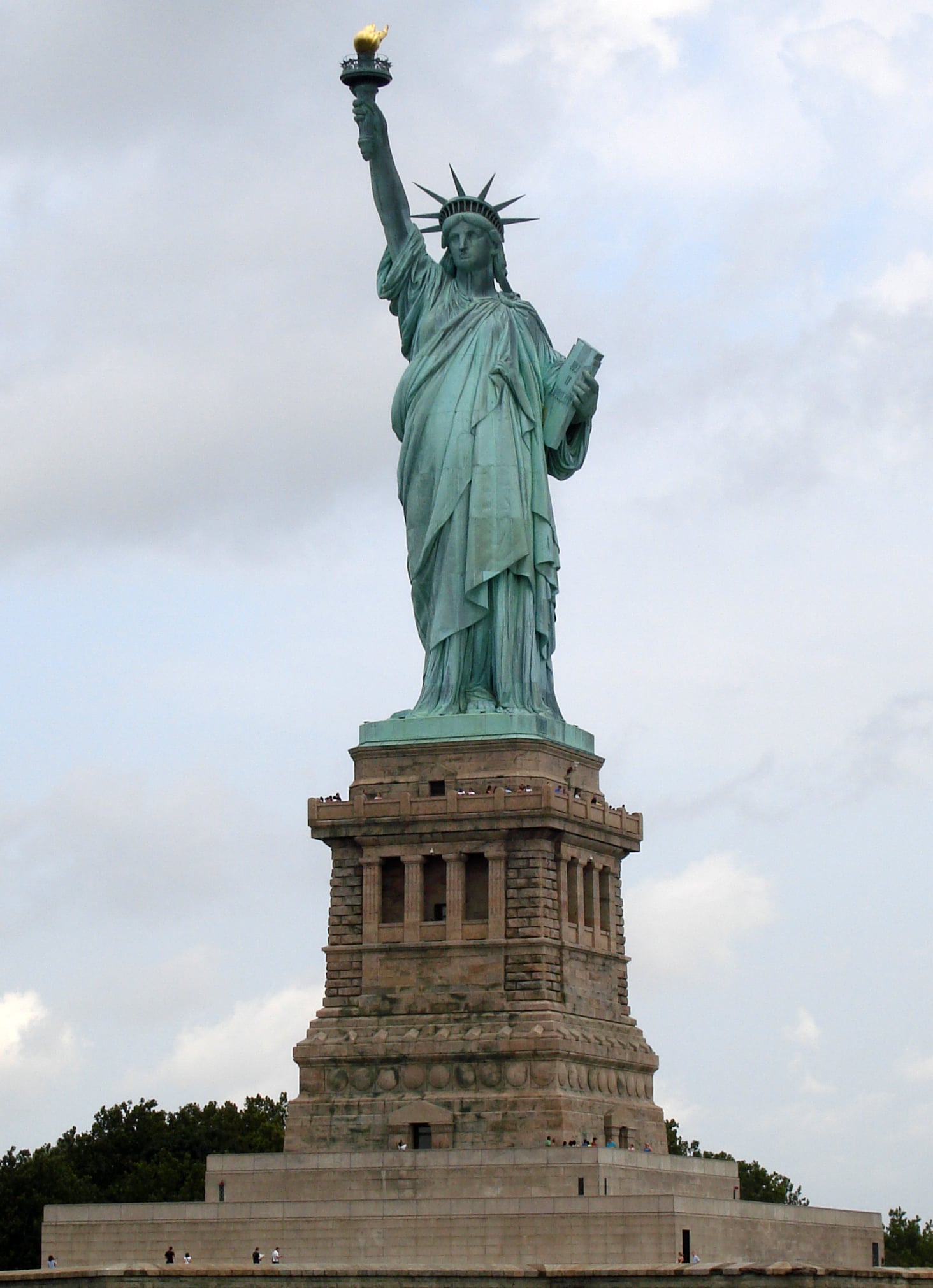
The Statue of Liberty is a giant copper statue that stands on a small island in New York Harbor. The full name is "Liberty Enlightening the World." The statue was a gift from the people of France to the people of the United States. It was finished in 1886 and has welcomed visitors and new arrivals to America ever since.
The statue shows a woman in long robes holding a torch high in her right hand. In her left arm, she carries a tablet with the date July 4, 1776, the day the United States declared independence. A broken chain lies at her feet. The chain stands for freedom from tyranny. She wears a crown with seven spikes around her head.
The statue is enormous. From the bottom of the base to the tip of the torch, she stands 305 feet tall. That is about as tall as a 30-story building. Her face alone is more than 8 feet long. Her index finger is 8 feet long. Inside the statue, visitors can climb 354 steps up a narrow staircase to reach windows in her crown.
The idea came from a French thinker named Édouard de Laboulaye in 1865. He admired American democracy and wanted to celebrate the friendship between France and the United States. A French sculptor named Frédéric-Auguste Bartholdi designed the statue. The inside metal frame was built by Gustave Eiffel, the same engineer who later built the Eiffel Tower in Paris. France paid for the statue. The United States paid for the stone base, called the pedestal.
The statue was built in France in pieces, then shipped across the Atlantic Ocean in 214 wooden crates. Workers put it back together on Bedloe's Island, now called Liberty Island. President Grover Cleveland unveiled it on October 28, 1886.
For millions of immigrants arriving by ship in the late 1800s and early 1900s, the statue was the first thing they saw of America. Most of them landed nearby at Ellis Island. Inside the pedestal is a poem by Emma Lazarus called "The New Colossus." Its most famous lines are: "Give me your tired, your poor, your huddled masses yearning to breathe free."
The statue was not always green. Copper starts out shiny and orange, like a new penny. Over about 30 years, the salty sea air turned the surface a soft blue-green. This coating, called a patina, actually protects the copper underneath from rusting away. So the statue's color is also part of what keeps her standing.
Related
Last updated 2026-04-26