
American Revolution
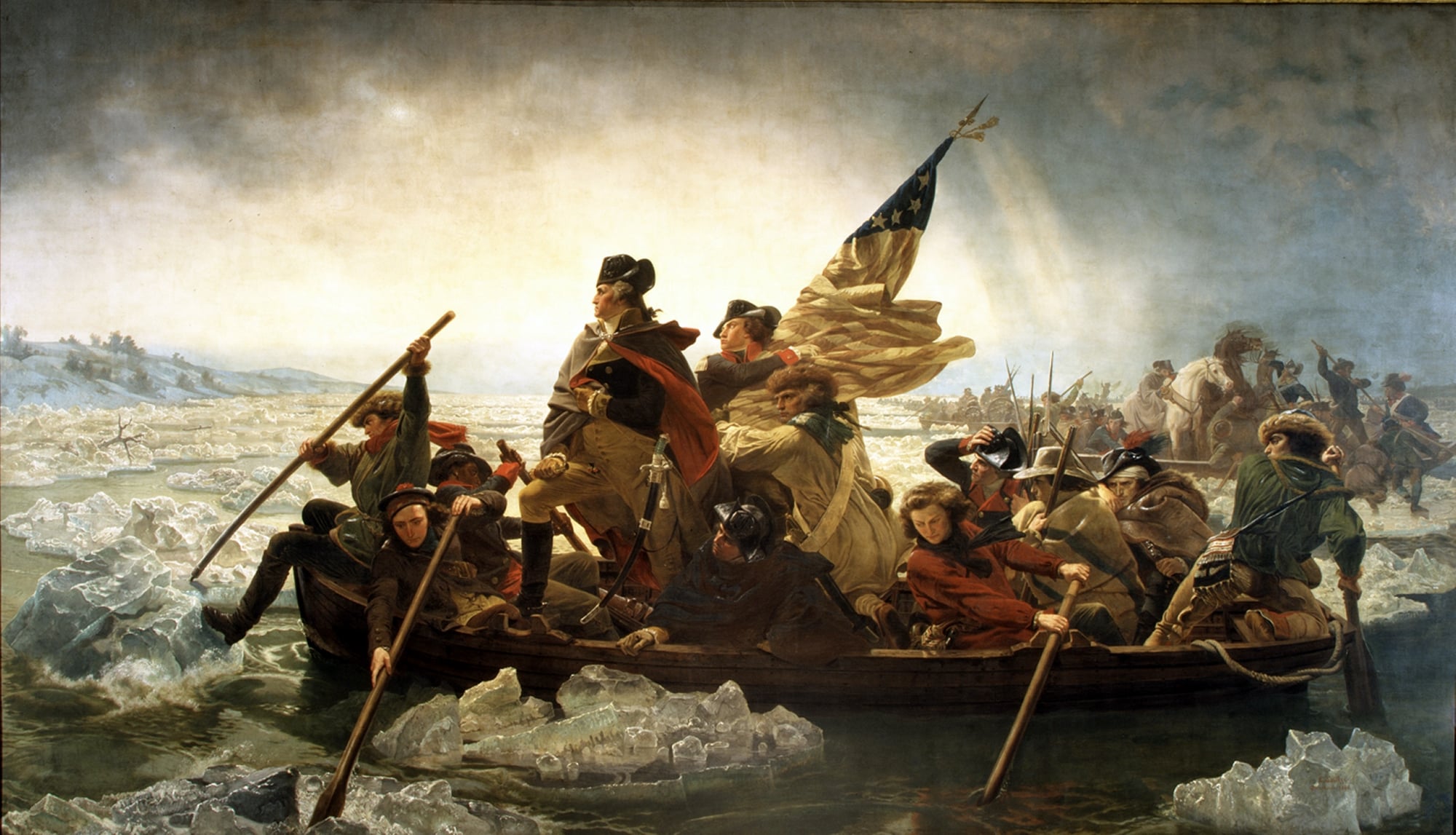
Credit: Emanuel Leutze · Public domain
The American Revolution was a war fought from 1775 to 1783. In it, thirteen American colonies broke away from Great Britain and became a new country, the United States. It was both a war and a political revolution. The colonists were not just fighting for new borders. They were fighting for a new idea: that people could rule themselves without a king.
Why the colonies were angry
In the 1760s, Great Britain ruled thirteen colonies along the east coast of North America. The colonies had grown rich from farming, fishing, and trade. Most colonists thought of themselves as British subjects with British rights.
Then Britain began passing new taxes. The country had just fought a long, expensive war against France. To pay for it, Parliament put taxes on sugar, paper, glass, paint, and tea. The colonists had no representatives in Parliament. They had no way to vote against these taxes. Their slogan became "No taxation without representation."
In 1773, a group of colonists in Boston dressed up, climbed onto British ships in the harbor, and dumped 342 chests of tea into the water. This was the Boston Tea Party. Britain was furious. It closed the port of Boston and sent more soldiers to control the city.
The fighting begins
The first shots were fired on April 19, 1775, in the small Massachusetts towns of Lexington and Concord. British soldiers marched out to seize colonial weapons. Local militia members, called Minutemen, were waiting. Nobody knows for sure who fired first. Eight colonists died on Lexington Green that morning. The war had started.
A few weeks later, leaders from each colony met in Philadelphia. They formed the Continental Army and chose George Washington to lead it. Washington was a Virginia farmer who had fought in earlier wars. He was calm under pressure and stayed loyal to the cause for the next eight years.
The Declaration of Independence
At first, many colonists still hoped to stay part of Britain. That changed in 1776. A writer named Thomas Paine published a small book called Common Sense. He argued that it was silly for a huge continent to be ruled by a tiny island across the ocean. The book sold hundreds of thousands of copies, an enormous number for that time.
On July 4, 1776, the Continental Congress approved the Declaration of Independence. Thomas Jefferson wrote most of it. The document said that all men are created equal and that governments get their power from the people they govern. Americans still celebrate July 4 as the country's birthday.
The words about equality were powerful, but they did not match reality. Jefferson himself owned enslaved people. Hundreds of thousands of Black Americans were enslaved in the new country. Women could not vote. Native nations were pushed off their land. Historians still debate how to weigh the Revolution's noble ideas against the people it left out.
A long, hard war
The war did not go well at first. Britain had the strongest army and navy in the world. American soldiers were often hungry, cold, and unpaid. In the winter of 1777 to 1778, Washington's army camped at Valley Forge, Pennsylvania. About 2,000 soldiers died there from cold and disease.
Two things turned the war around. First, in 1777, Americans won a major battle at Saratoga, New York. They captured an entire British army. Second, France decided to help the Americans. France was Britain's old enemy and was happy to see Britain in trouble. French ships, soldiers, and money made a huge difference. Spain and the Netherlands also joined against Britain.
The fighting did not stay in one place. Battles took place from Quebec to Georgia. Native nations were caught in the middle. Most sided with Britain, hoping to protect their lands from settlers. Many enslaved Black Americans escaped during the war. Some fought for the British, who promised them freedom. Others fought for the Americans.
Victory and a new country
The last big battle was at Yorktown, Virginia, in October 1781. Washington's army, helped by French troops and a French fleet, trapped a British army by land and sea. The British general surrendered. Two years later, in 1783, Britain and the United States signed the Treaty of Paris. Britain agreed that the United States was an independent country.
The new country still had to figure out how to govern itself. The first plan, called the Articles of Confederation, was too weak. So leaders met again in Philadelphia in 1787 and wrote the United States Constitution.
The American Revolution gave the world more than a new nation. It spread an idea: that ordinary people, not kings, could decide who governed them. Within a few years, that idea would help spark revolutions in France, Haiti, and across Latin America.
Related
Last updated 2026-04-26