
Declaration of Independence
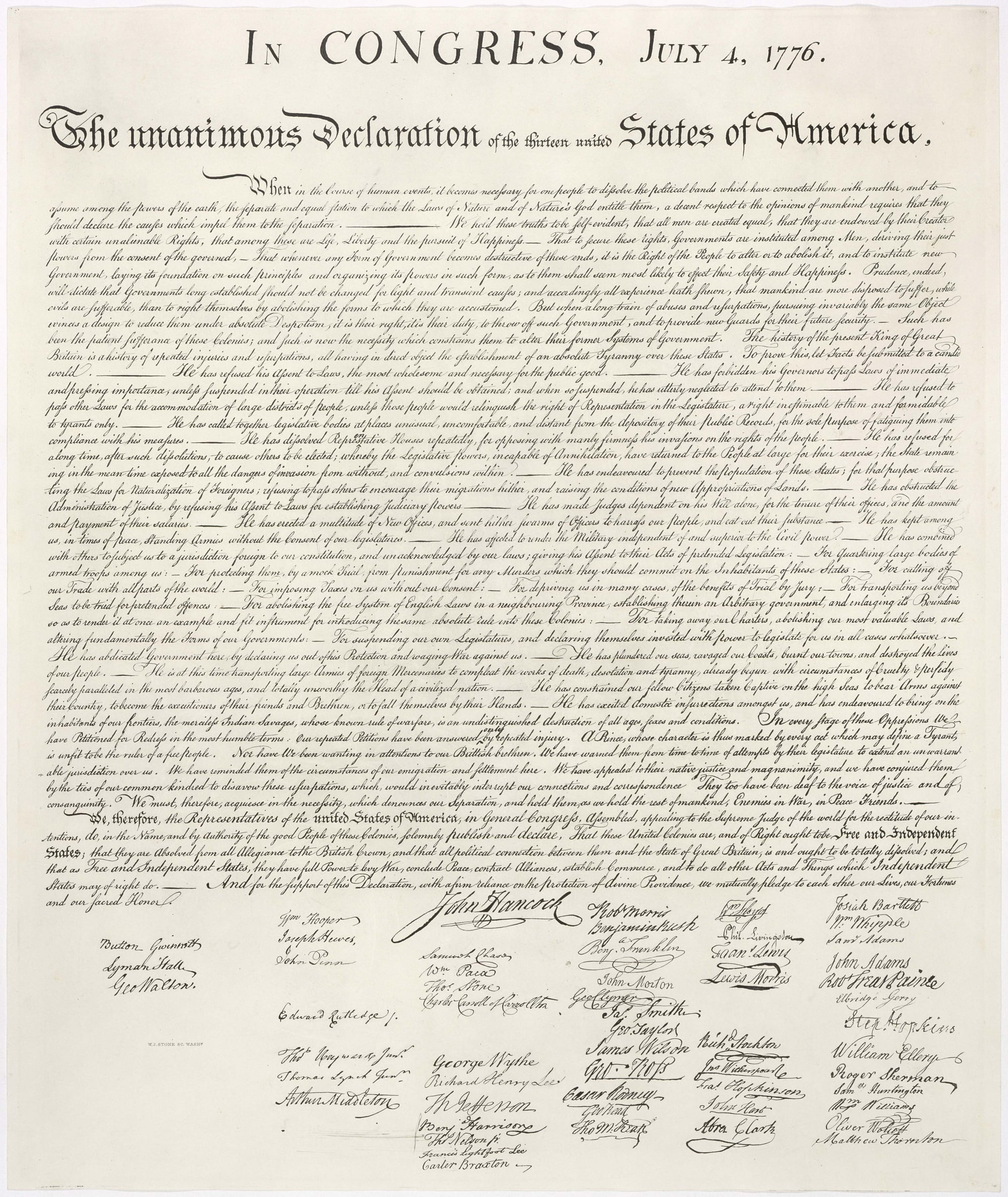
Credit: original: w:Second Continental Congress; reproduction: William Stone · Public domain
The Declaration of Independence is the document that announced the thirteen American colonies were breaking away from Great Britain to form a new country. It was adopted on July 4, 1776, in Philadelphia. The document was approved by the Continental Congress, a group of leaders chosen by the colonies. It explained why the colonies wanted to be free and what they believed about government.
For years before 1776, the colonies had been arguing with Britain. The British king, George III, was taxing the colonies without giving them a voice in Parliament. Colonists protested. Soldiers were sent. By April 1775, fighting had broken out at Lexington and Concord. For more than a year, the colonies fought a war while still officially part of Britain. Many leaders decided it was time to make the split official.
In June 1776, Congress chose five men to write the document. They were Thomas Jefferson, John Adams, Benjamin Franklin, Roger Sherman, and Robert Livingston. Jefferson, just 33 years old, did most of the writing. He worked alone in a rented room in Philadelphia for about 17 days. Adams and Franklin then made small changes before Congress reviewed it.
The most famous lines come near the beginning. Jefferson wrote that "all men are created equal" and that they have rights no government can take away, including "Life, Liberty and the pursuit of Happiness." These ideas were not new. Jefferson borrowed them from earlier thinkers like John Locke. But putting them at the start of a new nation's birth certificate was a powerful move.
The middle of the document is a long list of complaints against King George III. There are 27 of them. Jefferson accused the king of unfair taxes, of sending soldiers into people's homes, and of ignoring colonial laws. The ending declared the colonies "Free and Independent States."
The Declaration also has a painful contradiction. Jefferson wrote that all men are created equal while he himself enslaved more than 600 people during his lifetime. Slavery was legal in every colony in 1776. Some signers, like John Adams, opposed it. Many others did not. For the next 89 years, Americans would argue and eventually fight a civil war over whether the words "all men are created equal" really meant everyone.
Fifty-six men signed the Declaration. John Hancock signed first, in big bold letters. The original document is now kept at the National Archives in Washington, D.C., sealed in a special case filled with protective gas. The ink has faded, but the words have shaped American life for almost 250 years.
Related
Last updated 2026-04-26