
Space Shuttle
Credit: NASA · Public domain
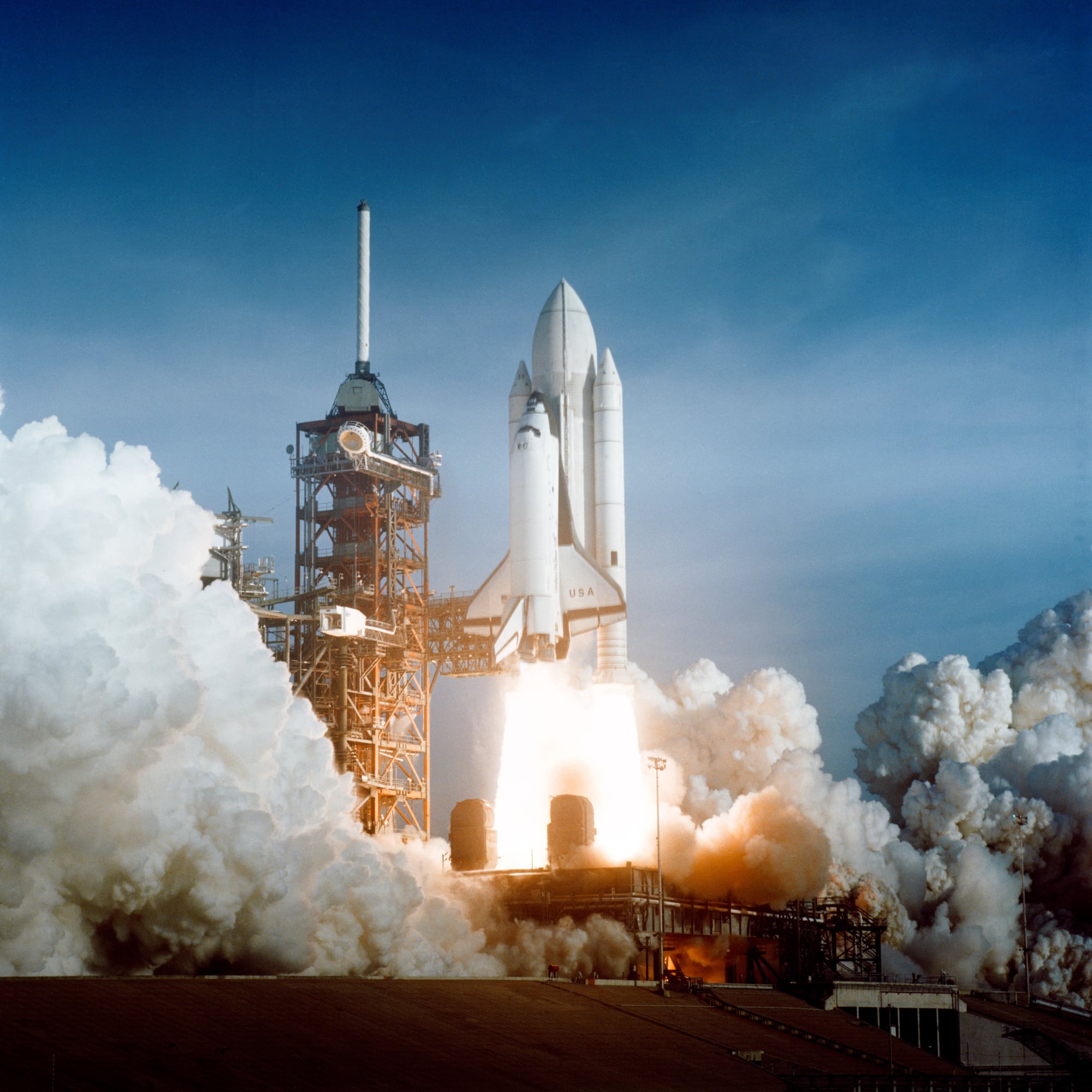
The Space Shuttle was an American spacecraft that carried astronauts and cargo into orbit around Earth. It was built by NASA and flew 135 missions between 1981 and 2011. Unlike earlier spacecraft, the Shuttle was designed to be used again and again. It launched like a rocket, worked like a spaceship in orbit, and then glided back to Earth to land on a runway, like an airplane.
The full Shuttle system had three main parts. The orbiter was the winged spacecraft where the astronauts lived and worked. A huge orange fuel tank held the liquid hydrogen and liquid oxygen that powered the orbiter's three main engines. Two tall white rockets, called solid rocket boosters, were strapped to the sides of the tank. They gave most of the push at liftoff, then dropped into the ocean to be fished out and used again.
Five orbiters flew in space: Columbia, Challenger, Discovery, Atlantis, and Endeavour. Each one was about 122 feet long, roughly the length of four school buses parked end to end. The cargo bay inside was big enough to hold a school bus of its own. That huge bay is what made the Shuttle special. It could carry satellites, big science experiments, and even pieces of a space station up to orbit.
The Shuttle built most of the International Space Station. Over more than a dozen missions, astronauts used the Shuttle's robotic arm to lift giant pieces into place and bolt them together. Shuttle crews also launched the Hubble Space Telescope in 1990 and went back five times to fix and upgrade it. Without those repair missions, Hubble would have been nearly blind.
The program had two terrible accidents. In 1986, Challenger broke apart 73 seconds after launch, killing all seven astronauts on board. A rubber seal on one of the boosters had failed in the cold morning air. In 2003, Columbia came apart as it returned to Earth. A piece of foam had struck its wing during launch, damaging the heat shield. All seven astronauts aboard Columbia died.
After Columbia, NASA decided the Shuttle was getting old and too risky. The last Shuttle flight, Atlantis, landed in July 2011. The four surviving orbiters now sit in museums, where visitors can walk right up to them.
The Shuttle was not perfect. It was expensive, and it never flew as often as NASA had hoped. Some engineers still argue about whether building it was the right choice. But for 30 years, it was the workhorse that carried America into space, and it taught the world how to live and build in orbit.
Related
Last updated 2026-04-22