
Nebula
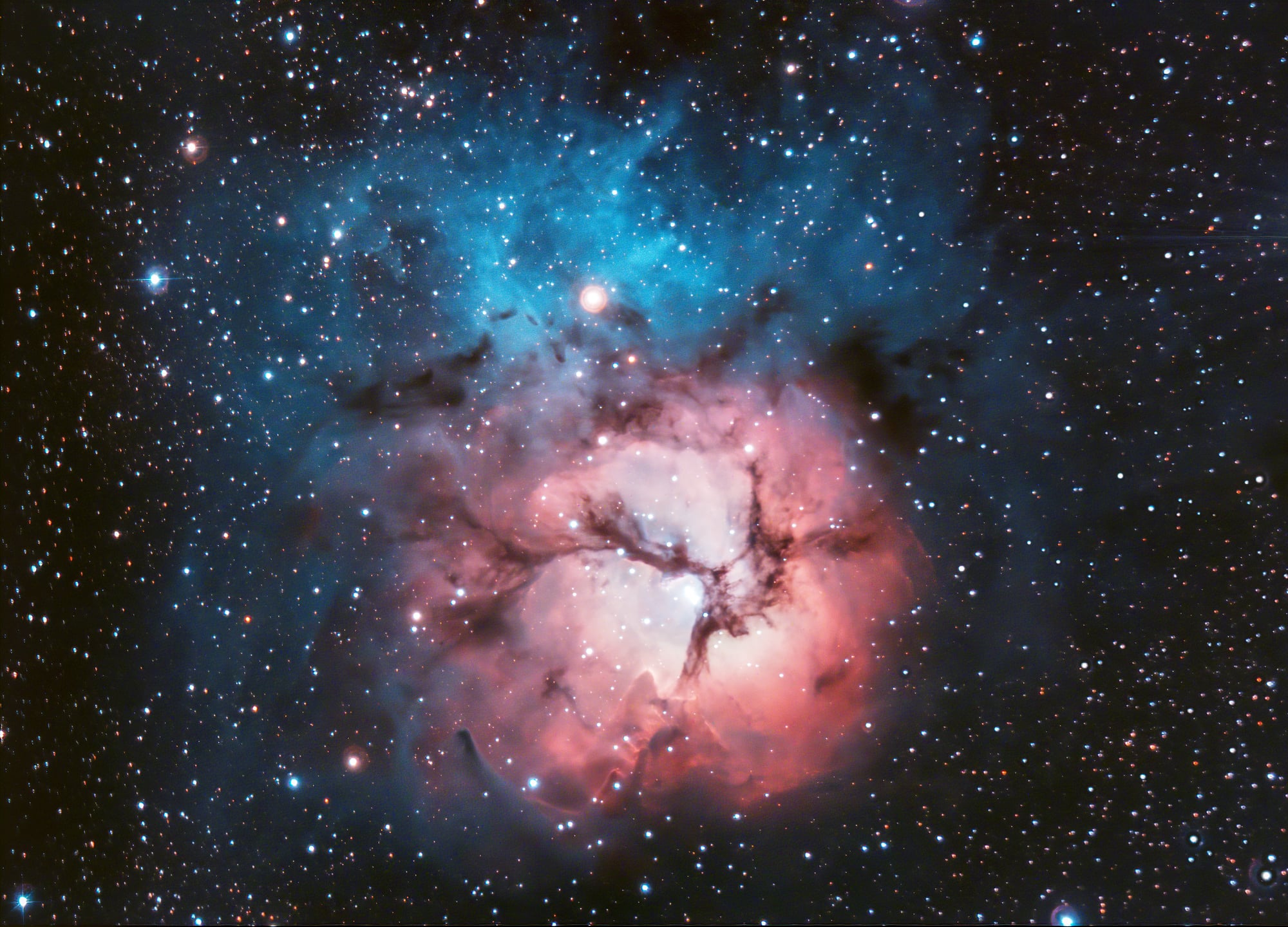
Credit: David (Deddy) Dayag · CC BY-SA 4.0
A nebula is a giant cloud of gas and dust floating in space. Most nebulas are made mostly of hydrogen, the simplest and most common gas in the universe. Some nebulas glow in bright colors. Others are dark patches that block the light of the stars behind them. The word "nebula" comes from the Latin word for cloud, and the plural is either "nebulae" or "nebulas."
Nebulas are huge. The Orion Nebula, one of the closest to Earth, stretches about 24 light-years across. That means light, the fastest thing in the universe, takes 24 years to travel from one side to the other. For comparison, light from the Sun reaches Earth in only 8 minutes.
There are a few main kinds of nebulas. Some are places where new stars are being born. Gravity pulls the gas and dust together into clumps. When a clump gets thick and hot enough in the middle, it starts to shine as a new star. The Eagle Nebula is famous for a region called the Pillars of Creation, where young stars are forming right now inside towers of gas.
Other nebulas are the remains of stars that have died. When a very large star runs out of fuel, it explodes in a supernova. The blast throws its outer layers into space, where they glow for thousands of years. The Crab Nebula is one of these. Chinese and Arab astronomers saw the supernova that made it explode in the year 1054. Smaller stars, like our Sun will someday be, end their lives more gently. They puff off their outer layers into a round cloud called a planetary nebula.
Nebulas matter because they connect the life and death of stars. A star dies and spreads its gas into a nebula. That gas mixes with other clouds and eventually helps form new stars and planets. Almost every atom in your body, except for the hydrogen, was once inside a star that blew apart into a nebula. You are, in a real way, made of ancient star dust.
For a long time, astronomers used the word "nebula" for anything fuzzy in the sky. In the 1920s, Edwin Hubble proved that many of those fuzzy objects were actually other galaxies, far beyond our own Milky Way. Today the word is only used for clouds of gas and dust. The next time you look up at a dark sky, remember that between the stars, enormous clouds are quietly building the stars of the future.
Last updated 2026-04-22