
States of Matter
Credit: Arman Cagle · CC BY-SA 3.0
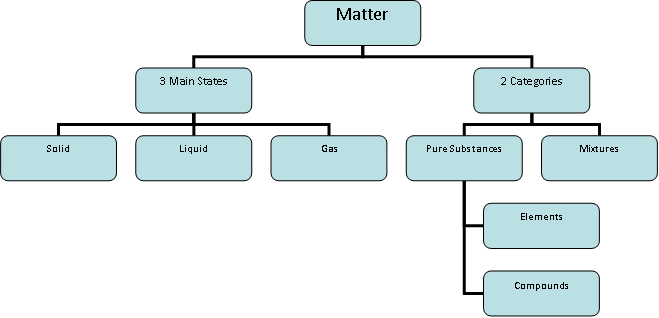
States of matter are the different forms that a substance can take. The three states you see every day are solid, liquid, and gas. A fourth state, called plasma, is less common on Earth but very common in space. The state a substance is in depends mostly on its temperature and the pressure around it.
All matter is made of tiny particles called atoms and molecules. These particles are always moving. What changes between states is how fast the particles move and how tightly they stick together.
In a solid, the particles are packed close and held in place. They can wiggle a little, but they cannot travel. That is why a solid keeps its shape. An ice cube on a table stays an ice cube. Wood, metal, rock, and bone are all solids.
In a liquid, the particles still touch, but they can slide past one another. A liquid takes the shape of whatever container you pour it into. Water fills a cup from the bottom up. The particles in water move about ten times faster than the particles in ice.
In a gas, the particles fly around freely with lots of empty space between them. A gas spreads out to fill any container it is in. The air around you is a gas made mostly of nitrogen and oxygen. If you could zoom in, you would see the molecules zipping past each other at roughly 1,000 miles per hour, faster than a jet plane.
Heat is what moves a substance from one state to another. Add heat to ice and it melts into water. Add more heat and it boils into steam. Take heat away and the steps run backward. Water is unusual because people see it in all three common states during normal weather. Most substances need very high or very low temperatures to change state.
Plasma is the fourth state. It forms when a gas gets so hot that the atoms break apart and electrons come loose. The sun is made of plasma. So are stars, lightning bolts, and the glowing gas inside a neon sign.
Scientists have also made other states of matter in labs. One is called a Bose-Einstein condensate. It only exists at temperatures colder than anything found in nature, just a hair above absolute zero. In that state, many atoms act like a single giant atom, a strange behavior scientists are still working to understand.
Last updated 2026-04-23