
Greenhouse Effect
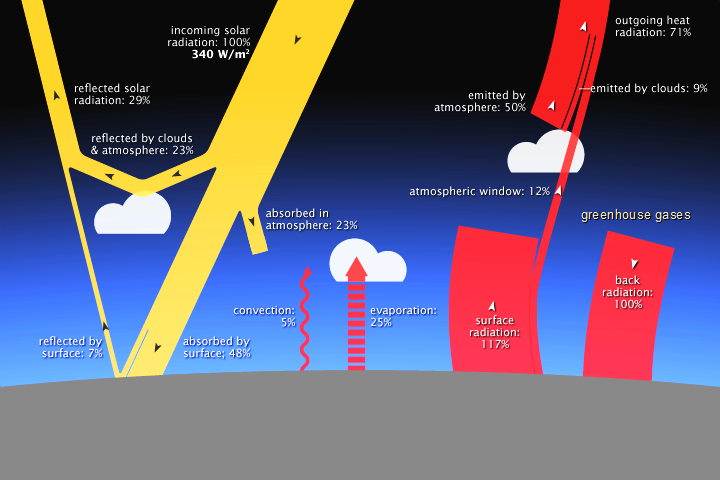
Credit: Robert Simmon · Public domain
The greenhouse effect is the way certain gases in a planet's atmosphere trap heat from the sun. These gases act like a warm blanket around the planet. They let sunlight in but slow the escape of heat back into space. Without this effect, Earth would be a frozen ball of ice. With too much of it, a planet can get dangerously hot.
The effect is named after a greenhouse, which is a building with glass walls used for growing plants. Sunlight passes through the glass and warms the air inside. The glass then keeps most of that warmth from leaking out. Earth's atmosphere does something similar, but with gases instead of glass.
Here is how it works. Sunlight travels 93 million miles through space and reaches Earth. Some of it bounces back off clouds and bright surfaces like snow. The rest is soaked up by the land, oceans, and air, which warm up. Warm things give off a kind of invisible heat called infrared radiation. Some of this heat escapes back into space. But certain gases in the atmosphere catch part of it and send it back toward the ground. That trapped heat keeps the planet warm enough for liquid water, plants, and animals.
The main gases that do this are called greenhouse gases. They include carbon dioxide, methane, water vapor, and nitrous oxide. They make up only a tiny slice of the atmosphere. Carbon dioxide, for example, is less than half of one percent. But even small amounts have a big effect on temperature.
People have changed how much of these gases are in the air. When we burn coal, oil, and gasoline, we release extra carbon dioxide. Cows and rice fields release methane. Cutting down forests also matters, because trees normally pull carbon dioxide out of the air. Since the 1800s, the amount of carbon dioxide in the atmosphere has risen by about 50 percent. Scientists agree that this extra gas is warming the planet. The warming is called climate change.
Other planets show what an extreme greenhouse effect looks like. Venus is about the same size as Earth, but its atmosphere is thick with carbon dioxide. The surface temperature there is around 870°F, hot enough to melt lead. Mars has the opposite problem. Its atmosphere is thin, so heat escapes easily, and the surface is bitterly cold.
The greenhouse effect itself is not a problem. It is what makes Earth livable. The problem is how quickly humans are making it stronger.
Related
Last updated 2026-04-23