
Mushroom
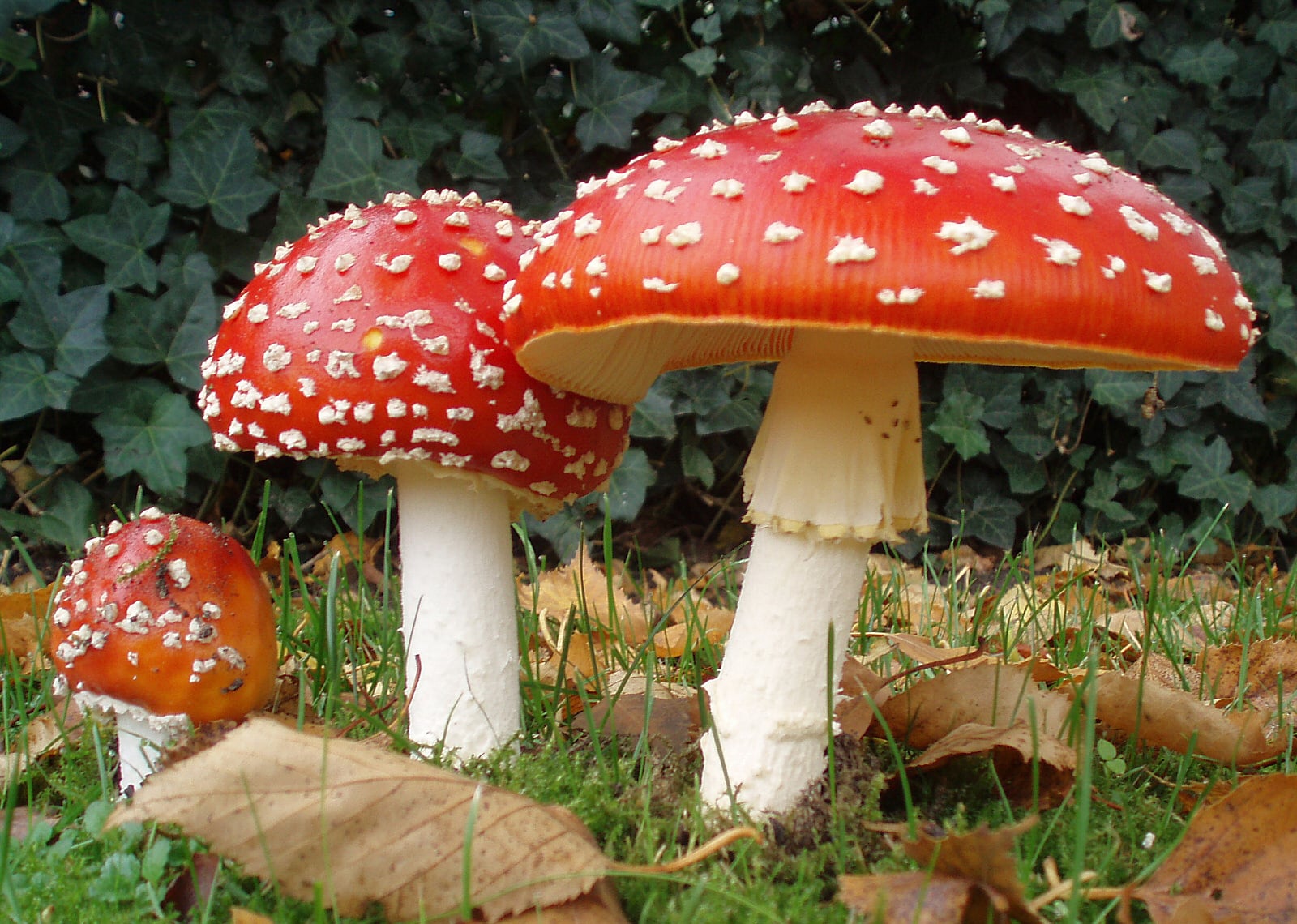
Credit: Amanita_muscaria_3_vliegenzwammen_op_rij.jpg: Onderwijsgek derivative work: Ak ccm · CC BY-SA 3.0 nl
A mushroom is the part of a fungus that grows above the ground to make spores. Spores are tiny cells that work like seeds. They float away on the wind and grow into new fungi. Most of the fungus actually lives hidden underground or inside dead wood. The mushroom is just the part you can see.
Mushrooms are not plants. Scientists used to group them with plants, but mushrooms cannot make their own food from sunlight the way plants do. Fungi belong to their own kingdom of living things. In some ways, fungi are closer to animals than to plants.
A typical mushroom has a stem and a cap. Under the cap, you will often find thin sheets called gills. The gills make millions of spores. A single mushroom can release more than a billion spores in just a few days. Most of those spores never grow, but a few will land in a good spot and start a new fungus.
The hidden part of the fungus is a web of thin white threads called mycelium. The mycelium spreads through soil, leaves, or rotting logs. It pulls in food by breaking down dead plants and animals. This makes fungi some of the most important recyclers on Earth. Without them, dead leaves and trees would pile up forever, and the nutrients trapped inside them would never return to the soil.
Mushrooms come in many shapes and colors. Some look like little umbrellas. Others look like coral, brains, or shelves growing out of tree trunks. Some glow in the dark. People have eaten mushrooms for thousands of years, and farmers grow many kinds, including button mushrooms, shiitakes, and portobellos.
But you should never eat a wild mushroom you find on your own. Some wild mushrooms are deadly poisonous, and a few of those look almost exactly like safe ones. The death cap mushroom, for example, can kill a person who eats just half of one. Even expert mushroom hunters use careful guidebooks and double-check every find.
Fungi also help in surprising ways. Many trees connect their roots to underground mycelium and share food and water through it. Scientists sometimes call this network the "wood wide web." Some fungi are used to make medicines, including penicillin, the first antibiotic. Other fungi flavor cheese, raise bread, and ferment soy sauce. The next time you walk through a damp forest, remember that the mushrooms popping up are only the tip of a much bigger living thing.
Last updated 2026-04-25