
Alps
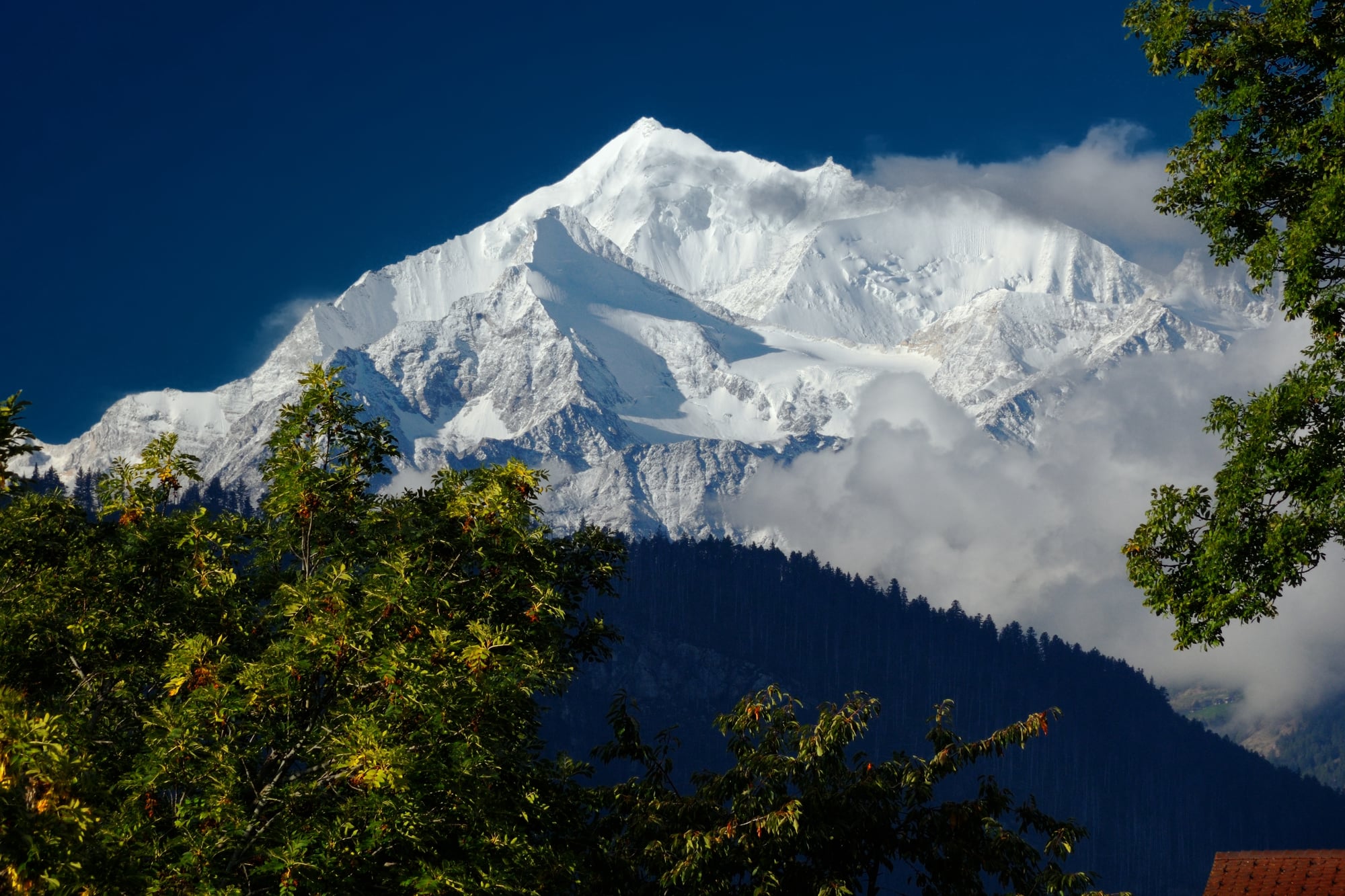
Credit: Zacharie Grossen · CC BY-SA 4.0
The Alps are a long chain of tall mountains in Europe. They stretch about 750 miles in a curve across eight countries: France, Italy, Switzerland, Germany, Austria, Slovenia, Liechtenstein, and Monaco. That is about the same distance as driving from New York City to Chicago. The Alps are the tallest mountain range that lies entirely within Europe.
The highest peak is Mont Blanc, which sits on the border between France and Italy. It rises 15,777 feet above sea level. That is almost three miles straight up. More than 100 peaks in the Alps stand higher than 13,000 feet. Another famous mountain is the Matterhorn, a sharp, pointed peak on the border of Switzerland and Italy. Its shape is so well known that it appears on candy bars and in theme parks.
The Alps were formed over millions of years. The African tectonic plate slowly pushed north into the European plate. Rock that was once under the sea got crumpled, folded, and shoved upward. The push is still happening today. The Alps grow a tiny bit taller each year, though erosion from wind, rain, and ice wears them back down.
Glaciers cover parts of the Alps. A glacier is a slow-moving river of ice. The largest is the Aletsch Glacier in Switzerland, which is about 14 miles long. Glaciers in the Alps are shrinking fast because of climate change. Some have lost more than half their ice in the last 150 years. Scientists think most small Alpine glaciers could be gone by the end of this century.
The Alps are the starting point for some of Europe's biggest rivers, including the Rhine, the Rhône, and the Po. Snow and glacier melt feed these rivers, which carry fresh water to farms and cities far away. Forests cover the lower slopes. Higher up, the trees stop growing and the ground turns rocky. Chamois, ibex, marmots, and golden eagles live in the high zones.
People have lived in the Alps for thousands of years. Villages tucked into mountain valleys raise cattle and make cheeses like Gruyère and Emmental, the cheese with the big holes. In 218 BCE, the general Hannibal famously crossed the Alps with an army that included war elephants, surprising the Romans. Today the mountains draw millions of visitors every year who come to ski, hike, and climb.
Related
Last updated 2026-04-23