
Mao Zedong
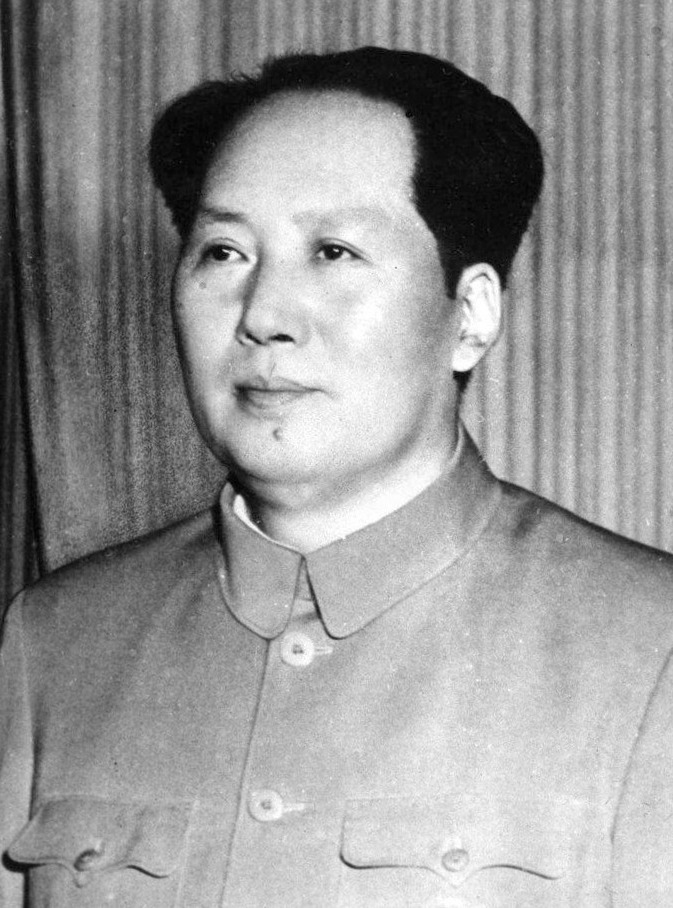
Credit: Chen Zhengqing (1917–1966) · Public domain
Mao Zedong was a Chinese revolutionary leader who founded the People's Republic of China in 1949. He ruled the country until his death in 1976. He is one of the most important figures in modern world history. He is also one of the most debated. Under his rule, China changed in huge ways, but tens of millions of people died from his policies.
Mao was born in 1893 in a small farming village in Hunan, in central China. His family were peasants, which means farmers who worked the land. As a young man, he read widely and became interested in new ideas about how to fix China. At the time, China was poor and had been pushed around by foreign powers for almost a hundred years.
In 1921, Mao helped start the Chinese Communist Party. The Communists wanted to take land away from rich landlords and give it to poor farmers. They soon went to war with another group called the Nationalists. The fighting lasted for more than 20 years, with a pause to fight Japan during World War II. In 1949, the Communists finally won. Mao stood in Beijing and announced the new People's Republic of China.
Once in power, Mao tried to change China very quickly. In 1958, he launched the Great Leap Forward. He wanted China to catch up with rich countries by making more steel and growing more food. The plan failed badly. Farms were forced to follow strict rules that did not work, and food ran out. A huge famine killed somewhere between 15 and 45 million people. Historians still argue about the exact number, but it was one of the worst famines in human history.
In 1966, Mao started another campaign called the Cultural Revolution. He told young people to attack teachers, officials, and anyone seen as old-fashioned. Schools closed. Books and temples were destroyed. Families were torn apart. The chaos lasted ten years and ruined millions of lives.
Mao died in 1976. His body is still on display in a glass case in Beijing. China today is very different from the country he left behind. It has factories, skyscrapers, and a huge economy.
How people remember Mao depends on where you ask. The Chinese government still honors him as the founder of modern China, and his face is on every yuan banknote. Many historians outside China focus on the famine and the Cultural Revolution. Both views are part of the same complicated story.
Related
Last updated 2026-04-26