
Northern Lights
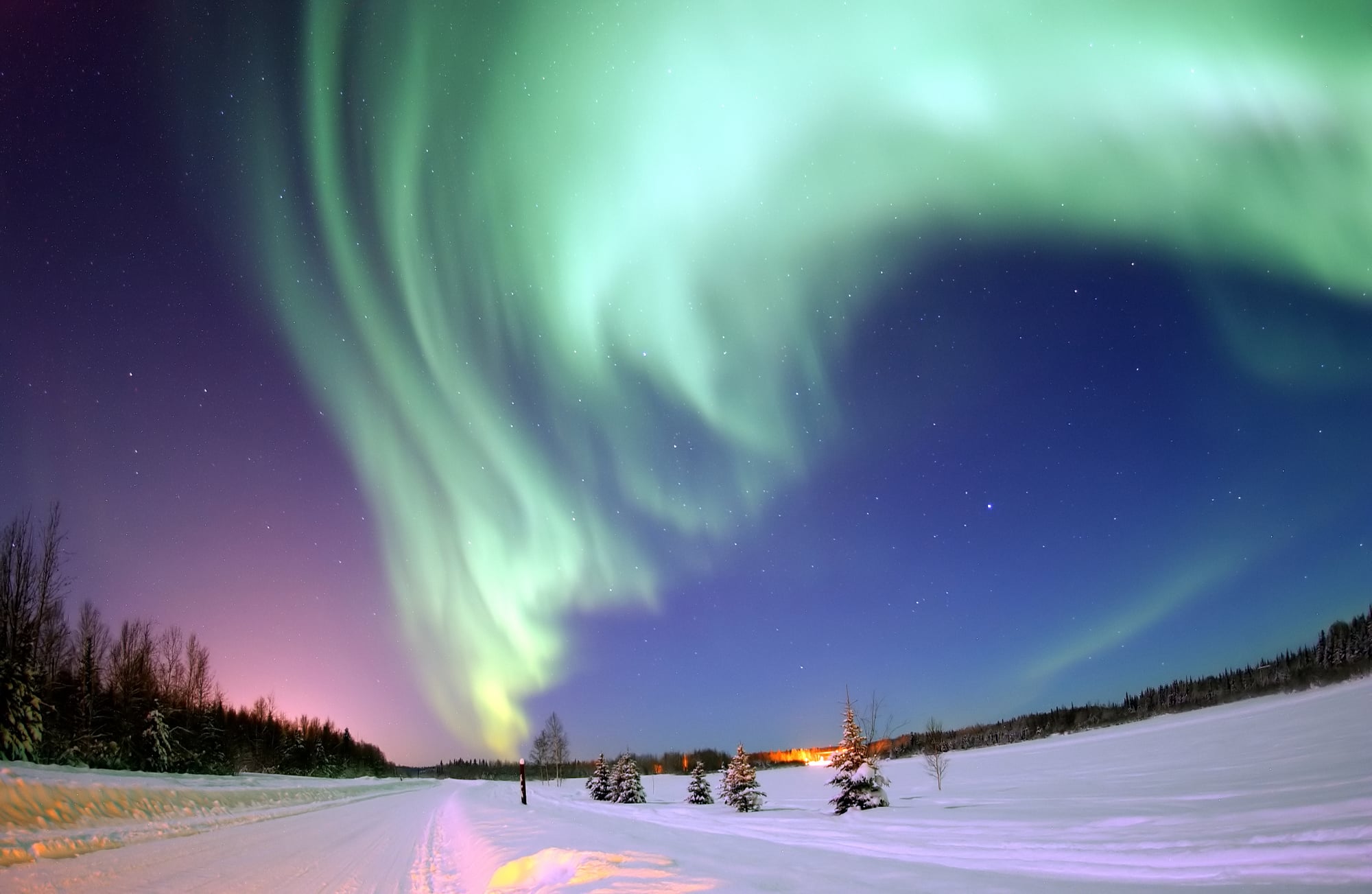
Credit: United States Air Force photo by Senior Airman Joshua Strang · Public domain
The Northern Lights are glowing waves of colored light that appear in the night sky near the North Pole. Their scientific name is the aurora borealis. The same kind of light shows up near the South Pole too, where it is called the aurora australis, or Southern Lights. People who live in Alaska, Canada, Iceland, Norway, Sweden, and Finland can sometimes see the aurora on clear, dark nights.
The lights look like curtains, ribbons, or rays that ripple across the sky. They are usually green, but they can also glow pink, red, purple, or blue. A strong display can fill the whole sky and last for hours.
The lights start with the Sun. The Sun is always sending out a stream of tiny particles called the solar wind. When the Sun has a big burst of activity, like a solar flare, it shoots out even more of these particles. They race through space and slam into Earth a day or two later.
Earth has a magnetic field, an invisible shield around the planet. The magnetic field pulls most of the particles toward the North and South Poles. Up there, the particles crash into gases high in our atmosphere. When a particle hits a gas atom, the atom gets extra energy. It quickly gives that energy back as a flash of light. Billions of these tiny flashes together make the glowing curtains we see.
Different gases glow different colors. Oxygen high in the atmosphere makes red light. Oxygen lower down makes the bright green that is most common. Nitrogen makes blue and purple. The shape of the curtains comes from the magnetic field, which guides the particles into long, curving paths.
The aurora happens about 60 to 200 miles above the ground. That is far higher than airplanes fly, and even higher than the International Space Station orbits in some spots. Astronauts have taken pictures of the Northern Lights from above, looking down at the glowing ring around the pole.
People have watched the Northern Lights for thousands of years. Long before scientists understood the Sun, many cultures made up stories to explain the lights. Some Inuit groups said the aurora was the spirits of the dead playing a game in the sky. Vikings thought the lights were reflections off the armor of warrior goddesses. The science is now well understood, but the lights still look like magic when you stand under them.
Related
Last updated 2026-04-25