
Cave
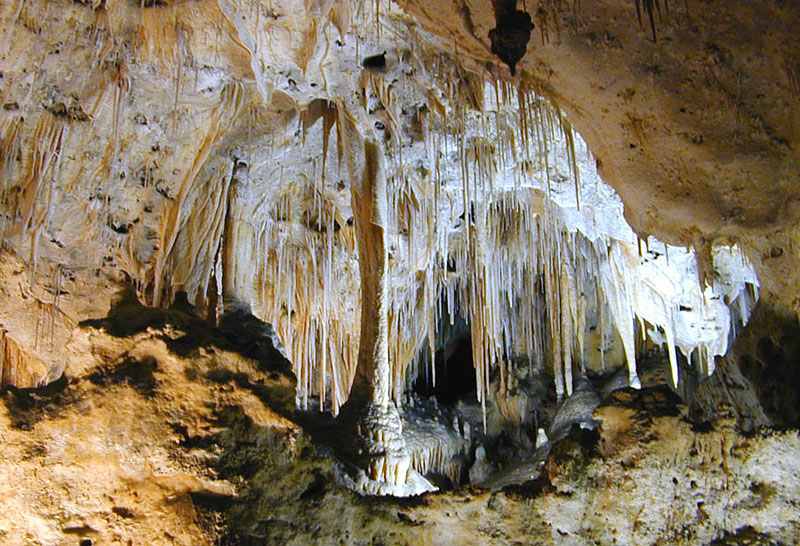
Credit: Eric Guinther, User:Marshman · CC BY-SA 3.0
A cave is a natural hollow space inside the Earth, large enough for a person to enter. Most caves form in rock, often in the sides of hills, mountains, or cliffs. Some are short and shallow. Others stretch for hundreds of miles underground. Caves are found on every continent, including under the ice of Antarctica.
Most of the world's biggest caves form in a soft rock called limestone. Rainwater soaks up a small amount of carbon dioxide as it falls through the air. This makes the water slightly acidic. When the water trickles into cracks in limestone, it slowly dissolves the rock. Over thousands of years, the cracks widen into tunnels and rooms. A cave that forms this way is called a solution cave.
Caves form in other ways too. Sea caves are carved by waves crashing against cliffs. Lava caves form when the outside of a lava flow hardens while hot lava keeps draining out from the inside, leaving a long tube. Glacier caves form when meltwater carves tunnels through ice.
Inside many limestone caves, water keeps doing slow work. Drips coming through the ceiling leave behind tiny bits of mineral. Over centuries, these bits build up into stone icicles called stalactites that hang from the ceiling. Where the drips land, matching stones called stalagmites grow up from the floor. A stalactite the size of your arm may have taken thousands of years to grow.
Caves are home to animals built for darkness. Bats sleep in caves by the thousands and fly out at night to hunt insects. Some cave fish, salamanders, and insects live their entire lives underground. Many of them are pale white and completely blind, because eyes and color are useless where no sunlight ever reaches.
People have used caves for as long as people have existed. Early humans sheltered in them, painted on their walls, and buried their dead inside. The cave paintings at Lascaux in France are about 17,000 years old. They show horses, deer, and bulls drawn with charcoal and colored clay, and they look almost fresh.
Cave explorers are called spelunkers or cavers. They use ropes, helmets, and headlamps to crawl through tight passages and climb down deep pits. The deepest known cave, Veryovkina Cave in the country of Georgia, drops more than 7,000 feet below the surface. That is deeper than five Empire State Buildings stacked on top of each other. New caves are still being discovered every year, and many that we know about have never been fully mapped.
Related
Last updated 2026-04-25