
Woodpecker
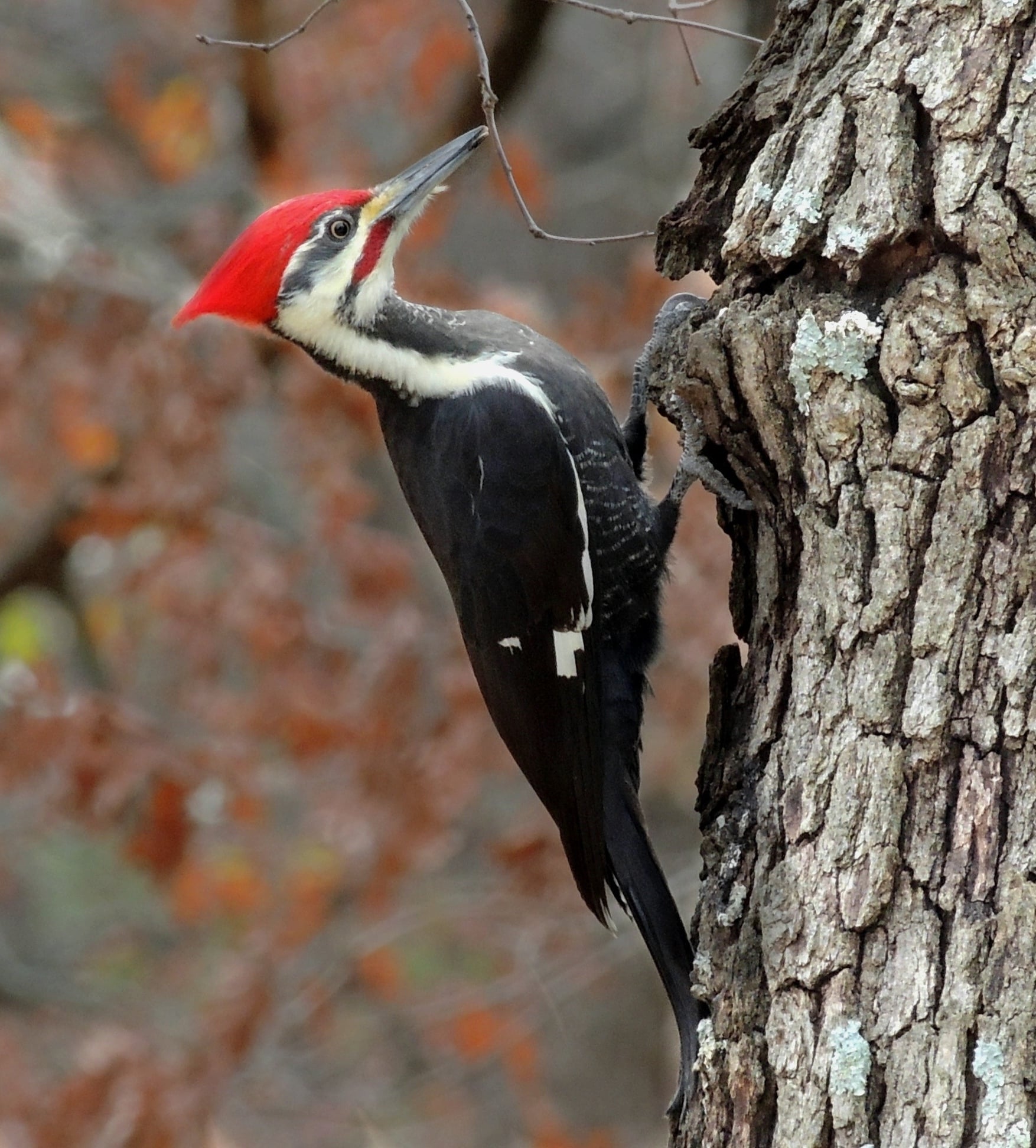
Credit: Joshlaymon · CC BY-SA 3.0
The woodpecker is a bird that uses its strong beak to drill into wood. There are more than 200 kinds of woodpeckers, and they live on almost every continent. The only places without them are Australia, Antarctica, and a few islands. Most woodpeckers make their homes in forests, but some live in deserts or on grassy plains with scattered trees.
Woodpeckers come in many sizes. The smallest is the bar-breasted piculet of South America, which weighs less than a nickel. The biggest is the great slaty woodpecker of Asia, which is nearly two feet long. In North America, the pileated woodpecker is the giant of the group. Its bright red crest stands up like a flame on top of its head.
A woodpecker's body is built for drilling. Its beak is shaped like a chisel. Its skull is thick and spongy, which cushions its brain against the shock of pounding. Its tongue is very long. In some species, the tongue is so long that it wraps around the back of the skull when not in use. The bird flicks this sticky tongue deep into holes to grab insects hiding in the wood.
Why do woodpeckers peck? They do it for three main reasons. They drill to find food, mostly ants, beetles, and grubs inside tree bark. They also hammer out holes to make nests. And they drum on loud surfaces to send messages to other woodpeckers, a little like a bird version of shouting. Some woodpeckers even drum on metal rain gutters because the sound carries farther.
Pecking that hard sounds like it should hurt. For a long time, scientists thought a woodpecker's skull worked like a built-in helmet. Newer studies have raised doubts. Some researchers now think the birds do feel small amounts of brain stress with each peck, but the force is so quick and small that it causes no lasting damage. The debate is still open.
Woodpeckers matter to the forest. The holes they carve become homes for other animals after the woodpeckers move on. Owls, squirrels, bats, and bluebirds all nest in old woodpecker holes. Because of this, scientists call woodpeckers a "keystone species." Take them away, and many other animals lose their homes.
One famous woodpecker may already be gone. The ivory-billed woodpecker of the American South has not been clearly seen since the 1940s. Most scientists think it is extinct. A few still search the swamps, hoping to prove them wrong.
Last updated 2026-04-22