
Turkey (bird)
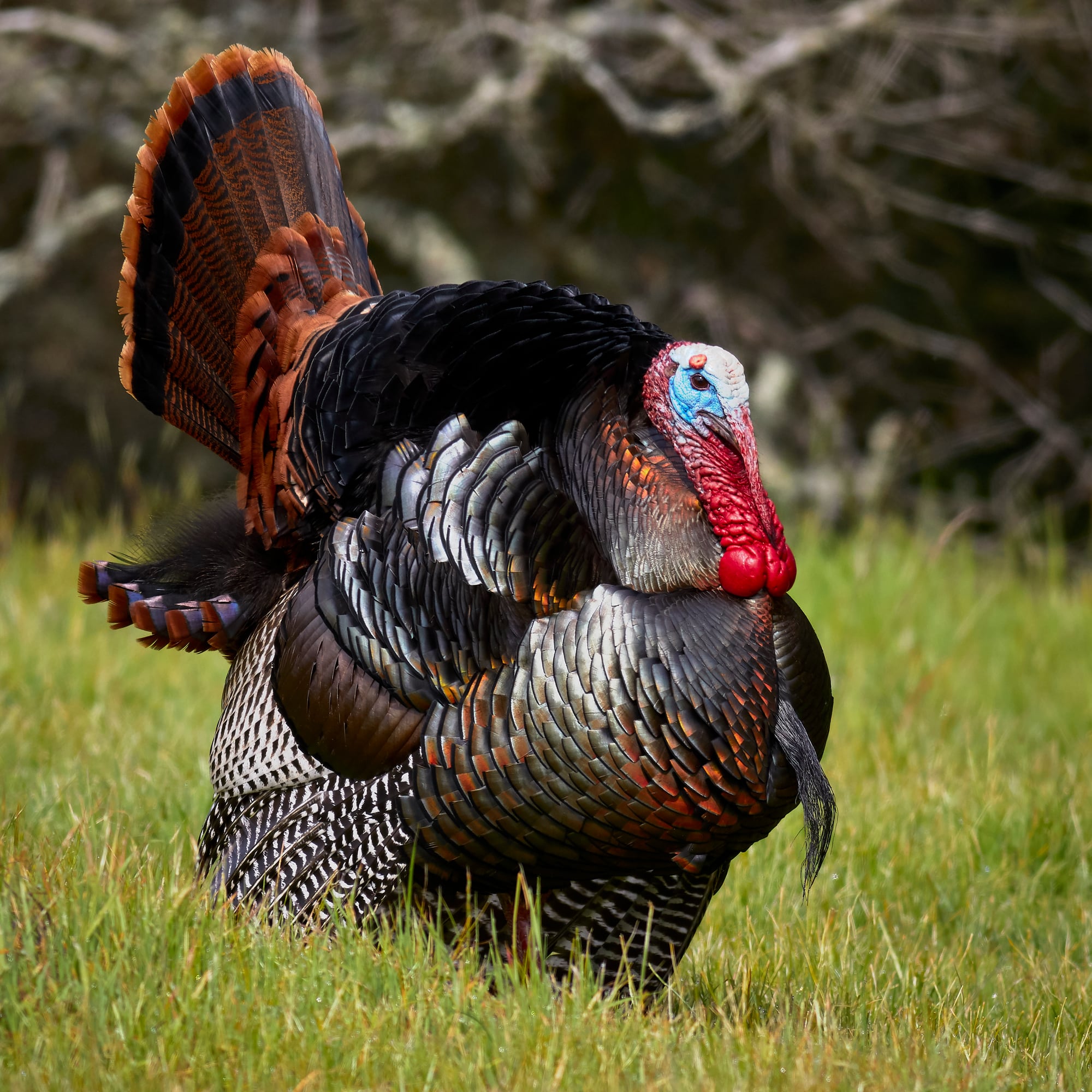
Credit: Frank Schulenburg · CC BY-SA 4.0
The turkey is a large bird from North America. It belongs to the same group of birds as chickens and pheasants. Turkeys have a round body, long legs, a bare head, and a flap of bumpy skin called a wattle that hangs under the beak. Males are bigger than females and grow a beard of stiff feathers on the chest. A wild male turkey, called a tom, usually weighs 15 to 25 pounds.
There are two kinds of turkeys alive today. The wild turkey lives in forests across the United States, southern Canada, and Mexico. The ocellated turkey lives only in the rainforests of Mexico, Belize, and Guatemala. The ocellated turkey has shiny blue, green, and bronze feathers that look almost painted.
Turkeys are better at flying than most people think. A wild turkey can sprint at 25 miles per hour on the ground. In short bursts, it can fly up to 55 miles per hour. Turkeys sleep high up in trees at night to stay safe from foxes and coyotes. Farm turkeys are a different story. People have bred them to grow huge breasts full of meat, and they are now too heavy to get off the ground.
A turkey's bare head can change color. When a tom is calm, his skin looks pale pink. When he gets excited or wants to impress a female, it turns bright red, white, and blue. He also puffs out his feathers, spreads his tail into a fan, and makes the famous "gobble-gobble" sound. A gobble can be heard a mile away.
Turkeys are part of American history. Native American people hunted and raised turkeys for thousands of years before Europeans arrived. By the early 1900s, wild turkeys had almost disappeared from the United States because of overhunting and lost forests. Only about 30,000 were left. Today, thanks to careful protection and forest replanting, more than 6 million wild turkeys roam North America again.
The turkey is also a symbol of American Thanksgiving. Families have eaten roast turkey on the holiday since the 1800s. Benjamin Franklin is often said to have wanted the turkey, not the bald eagle, as the national bird of the United States. That story is partly a myth. In a private letter to his daughter, Franklin did praise the turkey as "a much more respectable bird," but he never officially proposed it.
How did the bird get its name? English traders first saw a similar-looking bird that came through the country of Turkey, so they called it a "turkey." When they later met the American bird, they used the same name, even though the two birds were not closely related.
Related
Last updated 2026-04-22