
Great White Shark
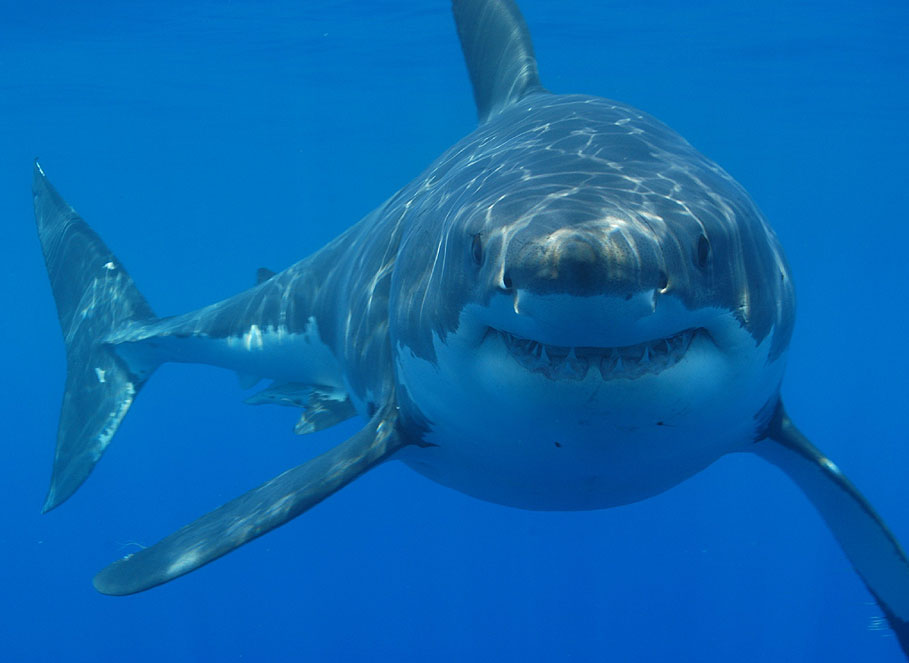
Credit: Hermanus Backpackers · CC BY 2.0
The great white shark is a large fish that lives in the cool coastal waters of every ocean except the Arctic. It is the biggest predatory fish in the world. An adult great white is usually 11 to 16 feet long. The largest ones ever measured were over 20 feet long, longer than a small camper van. A big adult can weigh more than 4,000 pounds, about as much as a grown hippo.
Great whites are easy to recognize. The top of the body is gray, and the belly is white. This coloring is a kind of camouflage called countershading. A seal looking up sees the white belly blending with the bright sky. A fish looking down sees the gray back blending with the dark ocean floor.
The mouth of a great white holds around 300 teeth, arranged in several rows. The front teeth do the biting. When one breaks off, a tooth from the row behind moves forward to replace it. A shark may go through thousands of teeth in its life. Each tooth is shaped like a triangle with sharp edges, perfect for cutting through blubber.
Great whites hunt mostly seals, sea lions, fish, and even small whales. They often attack from below, swimming up fast and bursting out of the water. Scientists call this a breach. A great white's senses are built for the hunt. It can smell tiny amounts of blood from far away. It can also feel the faint electric signals that every living animal gives off, using special pits on its snout called the ampullae of Lorenzini.
People are not on the menu. Most shark attacks on humans seem to be mistakes, when a swimmer or surfer looks like a seal from below. Great whites usually swim away after one bite. Still, movies like Jaws have made many people terrified of them. Shark experts say the real danger goes the other way. Humans kill far more sharks than sharks kill humans.
Scientists still have big questions about great whites. Nobody has ever filmed a great white giving birth in the wild. They are hard to keep in aquariums, and most die within weeks in captivity. Researchers also debate how long they live. New studies suggest great whites may live 70 years or more, much longer than anyone once thought.
Great whites are listed as vulnerable, which is one step away from endangered. Fishing nets, pollution, and the hunting of their favorite prey all threaten them. Protecting the top predator of the sea helps keep the whole ocean food web in balance.
Related
Last updated 2026-04-22