
Emu
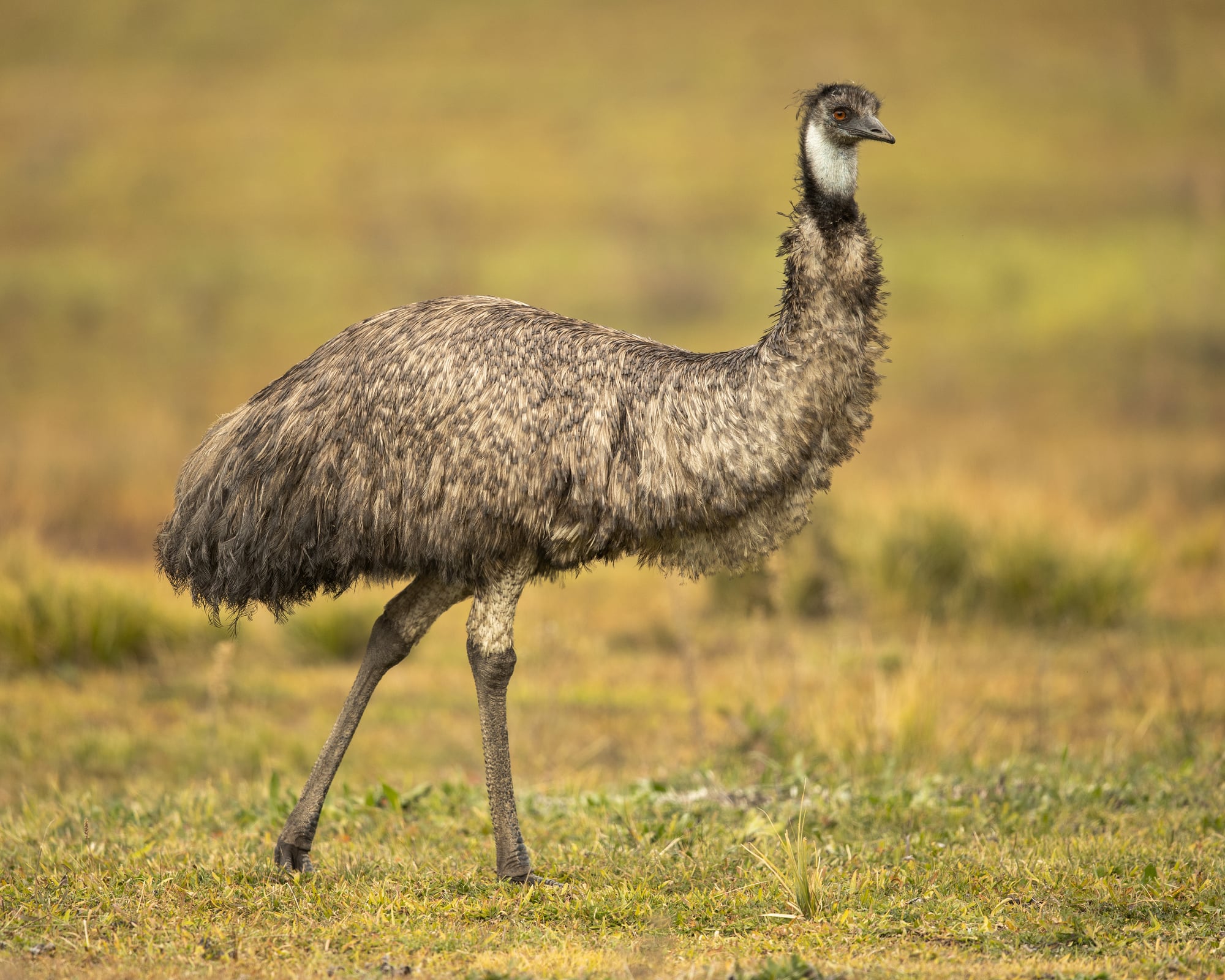
Credit: JJ Harrison (https://www.jjharrison.com.au/) · CC BY-SA 4.0
The emu is a large, flightless bird that lives in Australia. It is the tallest bird on that continent and the second-tallest bird in the world, after the ostrich. An adult emu stands about 5 to 6 feet tall, which is about the height of an adult human. It weighs between 70 and 120 pounds. Its feathers are shaggy and brown, and its neck and legs are long and bare.
Emus cannot fly. Their wings are tiny, only about 8 inches long, and are hidden under their feathers. What emus can do is run. They reach speeds of 30 miles per hour, almost as fast as a racehorse. Their long legs also let them take steps nearly 9 feet long at full speed. Each foot has three toes tipped with sharp claws, which can be used to kick predators like dingoes.
Emus live in many parts of Australia, from forests to grasslands to the edges of the desert. They eat plants, seeds, fruits, flowers, and insects. They also swallow small stones to help grind up food inside their stomachs. Emus can go weeks without food if they have to, and they are strong swimmers when they need to cross a river.
Emu family life is unusual. The female lays a clutch of 5 to 15 huge dark green eggs, each about the size of a softball. Then she leaves. The male sits on the eggs for about eight weeks, barely moving. He does not eat, drink, or leave the nest during that whole time. He can lose up to a third of his body weight. Once the striped chicks hatch, the father raises them on his own for up to 18 months.
One of the strangest events in emu history happened in 1932. Thousands of emus moved into farmland in Western Australia and started eating the crops. The Australian army sent soldiers with machine guns to stop them. The emus scattered, ran in zigzags, and mostly got away. The soldiers gave up after killing only a small number. Newspapers called it the Emu War, and the emus basically won.
Emus are not endangered today. In fact, there are hundreds of thousands of them in the wild, and many more are raised on farms for their meat, oil, and leather. The emu is also one of two animals on Australia's national coat of arms, along with the kangaroo. Australians chose these two animals partly because neither one can easily walk backward, a symbol for a country always moving forward.
Last updated 2026-04-22