
Earthworm
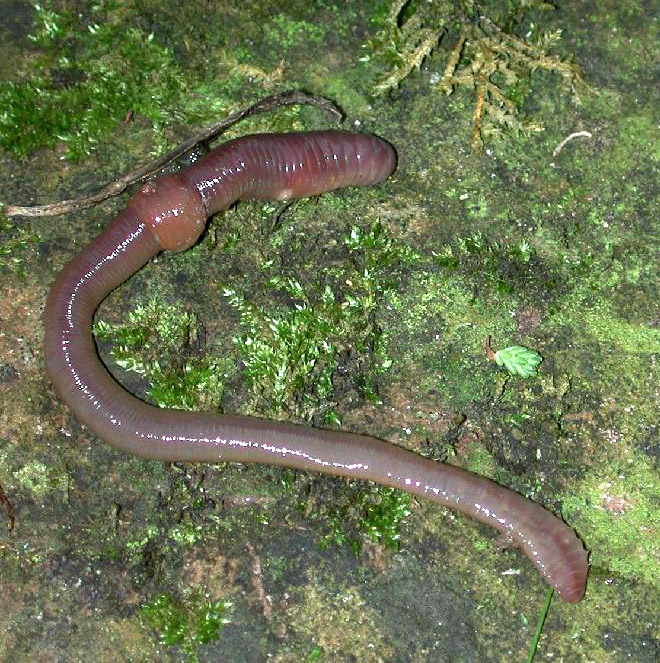
Credit: Michael Linnenbach · CC BY-SA 3.0
The earthworm is a long, thin animal that lives in soil. It belongs to a group of animals called annelids, which means "ringed" animals. If you look closely at an earthworm, you can see the rings that divide its body into segments. A single worm can have more than 100 of these segments. Earthworms live on every continent except Antarctica.
Earthworms do not have bones. They do not have lungs either. Instead, they breathe through their skin, which has to stay damp for the breathing to work. That is why worms come to the surface when it rains. If their tunnels fill with water, they can still get enough oxygen above ground. It is also why a worm stuck on hot pavement dries out and dies so quickly.
A worm moves by squeezing and stretching its body. Tiny bristles called setae stick out from each segment and grip the soil. The front of the worm pushes forward, then the back catches up. Worms do not have eyes, but they can sense light through their skin. They almost always move away from bright light and toward cool, damp darkness.
What do earthworms eat? Dirt. More exactly, they eat the dead leaves, roots, and tiny bits of once-living matter mixed into soil. A worm swallows soil at one end, pulls out the nutrients inside its body, and passes the rest out the other end. The waste is called a casting. Worm castings are one of the richest natural fertilizers on Earth. A single acre of healthy farmland can hold a million earthworms, and together they can produce tons of castings every year.
Earthworm tunnels also help soil. The tunnels let air and water move down to plant roots. Without worms, soil gets hard and packed. With worms, it stays loose and full of life. Farmers and gardeners love them for this reason.
Charles Darwin, the scientist famous for his ideas about evolution, thought earthworms were amazing. He studied them for almost 40 years. He calculated that worms slowly turn over every bit of soil in a field, pulling leaves down and mixing the ground from below. "It may be doubted," he wrote, "whether there are many other animals which have played so important a part in the history of the world."
Most earthworms are only a few inches long. But the giant Gippsland earthworm of Australia can grow up to 10 feet, longer than a tall adult is tall. When it moves through its tunnel, you can sometimes hear a gurgling sound from above the ground.
Last updated 2026-04-22