
Baboon
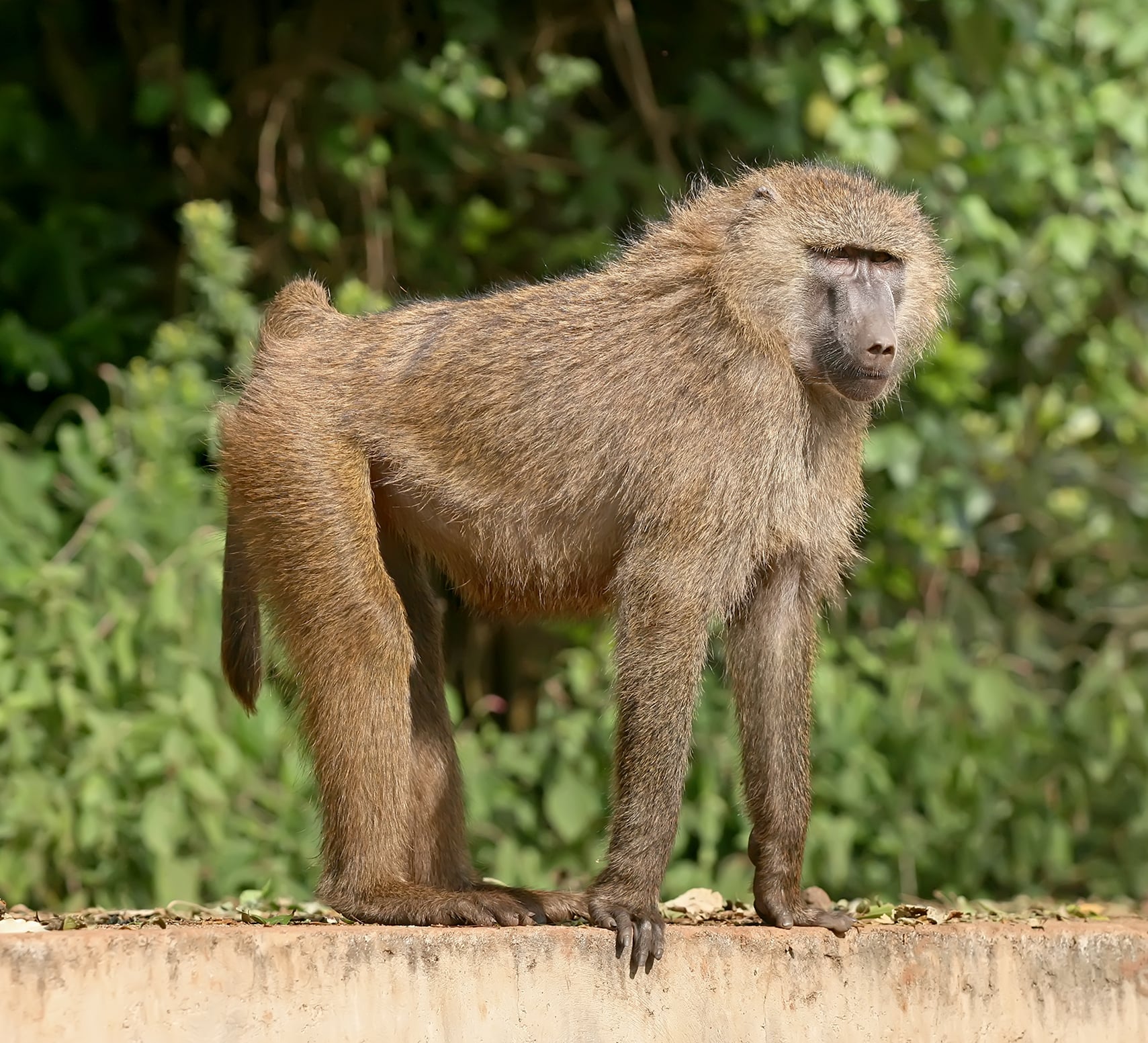
Credit: Muhammad Mahdi Karim · GFDL 1.2
The baboon is a large monkey that lives in Africa and in a small part of the Arabian Peninsula. There are six kinds of baboons, and all of them belong to the same group of animals. Baboons have dog-like faces, strong jaws, and long tails that curve upward. An adult male can weigh up to 90 pounds, about as much as a large dog. Males are usually twice the size of females.
Baboons spend most of their day on the ground. This makes them different from many other monkeys, which live mostly in trees. Baboons walk on all fours across grasslands, rocky hills, and the edges of forests. At night, they climb into tall trees or onto cliffs to sleep. Sleeping up high keeps them safe from leopards, lions, and hyenas.
Baboons live in big family groups called troops. A troop can have as few as 10 members or as many as 200. Life in a troop is busy and noisy. Baboons groom each other by picking through fur to remove dirt and bugs. Grooming is not just about being clean. It is also how baboons make friends and calm each other down.
Baboons will eat almost anything. Their diet includes grass, seeds, fruit, roots, insects, birds' eggs, and sometimes small animals like hares or young antelope. This flexible diet is one reason baboons survive in so many different places. In towns near their habitat, baboons sometimes raid gardens, trash cans, and even open car windows to grab food.
Baboons are smart. Scientists have found that they can tell the difference between real words and random letter patterns on a screen. They also remember the faces and voices of other baboons in their troop for years. Young baboons learn by watching adults, much like human children do.
Ancient people paid close attention to baboons. In ancient Egypt, baboons were linked to Thoth, the god of writing and wisdom. Egyptians carved baboons into temples and sometimes mummified them. Some mummies were buried near pharaohs so the animals could guide them in the afterlife.
Most kinds of baboons are doing well today, which is rare for large African mammals. They are not in danger of dying out. But one kind, the Guinea baboon, is near threatened because people are clearing the forests and grasslands where it lives. Where baboons share land with farms and towns, people and baboons often bump into each other, and scientists are still working out how both can share space safely.
Related
Last updated 2026-04-22