
Microscope
Credit: Ann 2000 · CC BY-SA 4.0
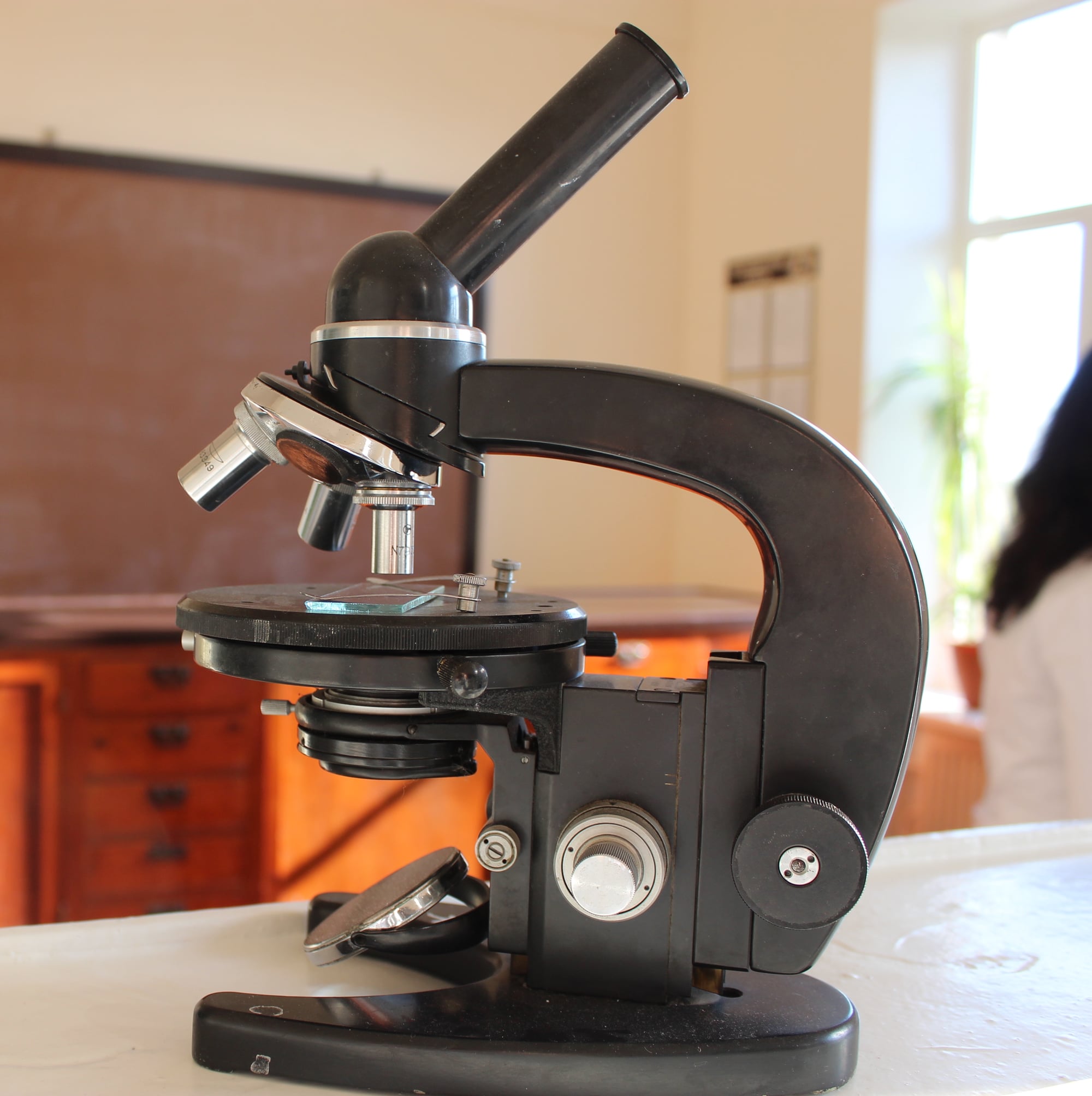
A microscope is a tool that uses lenses to make small things look much bigger. It lets people see objects too tiny for the human eye, like the cells inside a leaf or the bacteria in a drop of pond water. Most school microscopes can magnify things 40 to 400 times their real size. The most powerful research microscopes can show single atoms.
The first microscopes were invented in the Netherlands around 1590. A Dutch glasses maker named Zacharias Janssen and his father are usually given credit. They put two lenses inside a tube and noticed that objects at one end looked huge when you peeked through the other end. Their device was simple, but it opened a door no one had ever opened before.
The most famous early user of the microscope was another Dutchman, Antonie van Leeuwenhoek. In the 1670s, he ground his own tiny lenses and built microscopes that were better than anyone else's. When he looked at a drop of water, he saw something amazing. Tiny creatures were swimming around inside it. He called them "animalcules," meaning little animals. We now call them microorganisms. Van Leeuwenhoek was the first person ever to see bacteria.
A simple microscope works using light. Light bounces off the object you are looking at and passes through curved glass lenses. The lenses bend the light in a way that makes the image look bigger to your eye. This kind of microscope is called an optical microscope, and most classrooms still use one.
Some things are too small for light to show. To see them, scientists invented the electron microscope in the 1930s. Instead of light, it uses a beam of tiny particles called electrons. Electron microscopes can magnify things up to two million times. They are how we got our first pictures of viruses, which are far too small to see with light.
The microscope changed science forever. Before it existed, no one knew that living things were made of cells. No one knew that germs caused diseases. Doctors had no idea why people got sick. Once microscopes revealed bacteria and viruses, scientists could finally understand infection, develop vaccines, and create medicines that save lives every day.
The next time you look at a drop of pond water, remember that a whole busy world is hiding inside it. People could not see that world for most of human history.
Last updated 2026-04-25