
Periodic Table
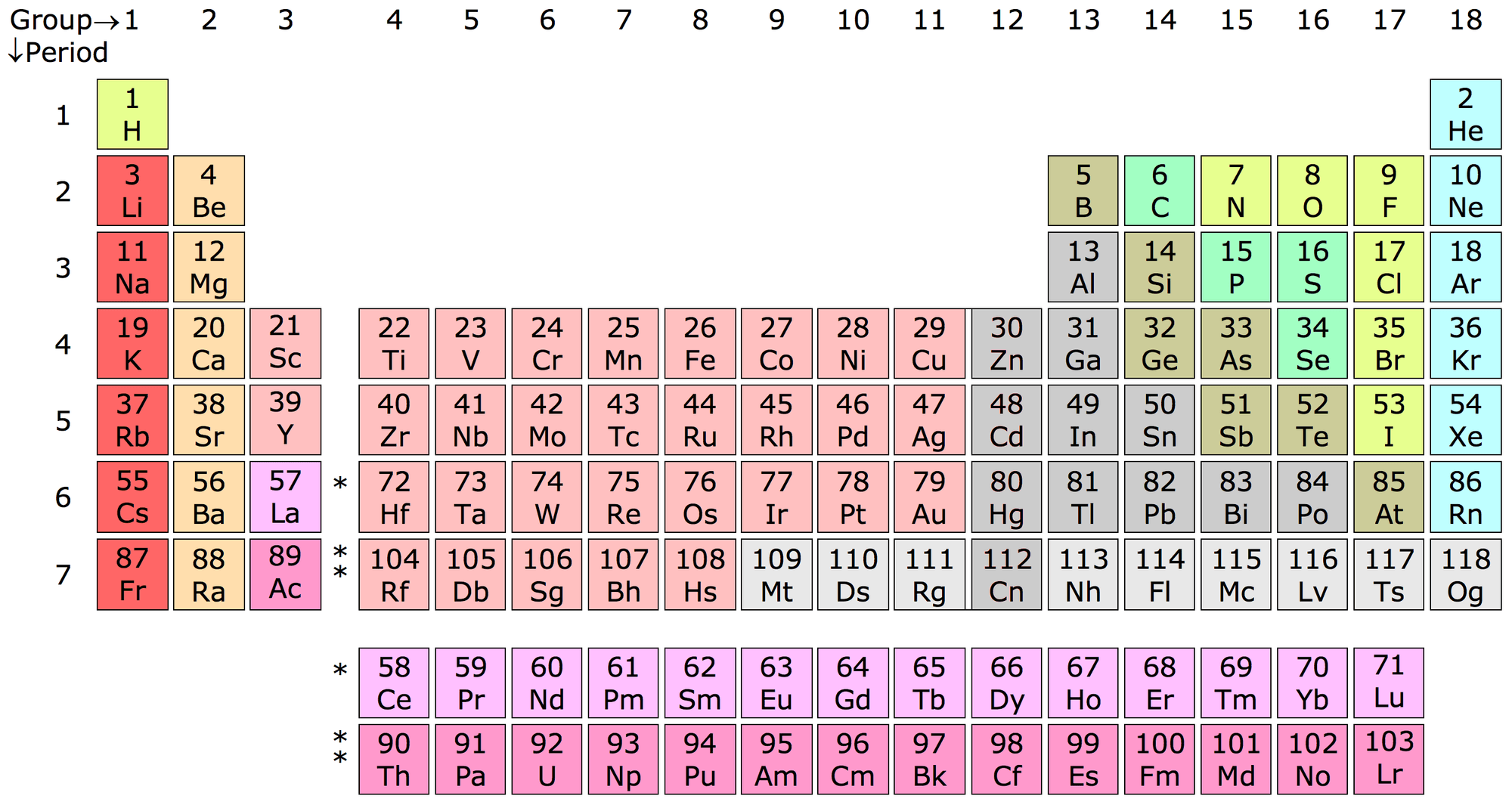
Credit: abhishek · CC BY-SA 4.0
The periodic table is a chart that lists all the known chemical elements. An element is a pure substance made of just one kind of atom. The table arranges the elements in a special order so that their patterns become easy to see. Scientists use it every day to understand how matter behaves.
Each element sits in its own box. The box shows the element's name, its chemical symbol, and its atomic number. The atomic number is the number of protons in one atom of that element. Hydrogen has one proton, so it is number 1. Oxygen has eight, so it is number 8. Gold has 79.
The rows of the table are called periods. The columns are called groups. Elements in the same group act in similar ways. For example, the elements in the far-right column are called the noble gases. They almost never react with other elements. The elements in the far-left column, like sodium and potassium, are so reactive that they can catch fire when they touch water.
A Russian scientist named Dmitri Mendeleev made the first useful periodic table in 1869. He lined up the known elements by their weight and noticed a pattern. He was so sure of the pattern that he left empty spots for elements he believed had not been discovered yet. He even predicted what those missing elements would be like. When scientists later found gallium and germanium, they matched his predictions almost exactly.
There are 118 confirmed elements today. About 90 of them occur naturally on Earth. The rest are made by humans in laboratories, usually by smashing atoms together in giant machines. These human-made elements are very unstable. Some exist for less than a second before falling apart.
Every single thing you can see or touch is built from elements on this table. Water is made of hydrogen and oxygen. Your bones are mostly calcium and phosphorus. The air you breathe is mostly nitrogen. Even stars are made of elements, mainly hydrogen and helium.
Scientists are still trying to make new elements past number 118. The work is very hard, and each new element lasts only a tiny fraction of a second. Researchers also argue about whether the table should be arranged differently to show the patterns even better. Some have drawn it as a spiral or a pyramid. The standard flat chart you see on classroom walls is just one way to show the same deep idea: matter follows rules, and the rules repeat.
Last updated 2026-04-23