
Willow
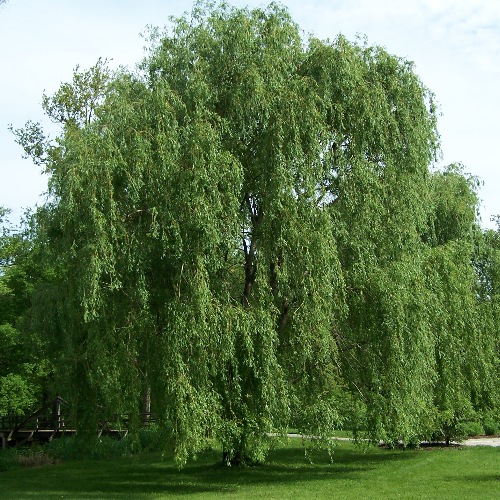
Credit: Bruce Marlin · CC BY 3.0
The willow is a tree or shrub that grows near water in cool parts of the world. There are about 400 different kinds of willow. Most live in North America, Europe, and Asia, and a few grow as far north as the Arctic. Willows are known for their long, thin leaves and their bendy branches. They almost always grow close to rivers, ponds, lakes, or wet ground.
The most famous kind is the weeping willow. Its branches hang straight down toward the ground, like long green hair. A full-grown weeping willow can reach 50 feet tall and just as wide. Other willows are very different. Some are small bushes only a few feet high. The Arctic willow, which grows on the cold tundra, hugs the ground and rarely gets taller than six inches.
Willows love water. Their roots spread out wide and deep, hunting for it. The roots are so strong and so thirsty that they can break into underground pipes looking for a drink. For this reason, people are careful not to plant willows too close to houses or sewer lines. But the same hungry roots make willows useful along riverbanks. They hold the soil in place and keep it from washing away during floods.
Willow wood is light and bendy. People have used it for thousands of years to weave baskets, fences, and furniture. The bendy branches are also used to make cricket bats and the wooden frames of some boats. In England, a special kind called the cricket-bat willow is grown just for this purpose.
Willow bark holds a chemical called salicin. Thousands of years ago, people in ancient Egypt, Greece, and China learned to chew the bark or boil it into tea to ease headaches and fevers. In the 1800s, scientists studied salicin and used it to create a new medicine: aspirin. Aspirin is now one of the most common pain relievers in the world, and it began with the willow.
Willows also play a part in many stories. In Chinese poems and paintings, the willow stands for spring and gentle sadness. In old European folktales, willow branches were thought to keep away bad luck. The trees show up in songs, on pottery, and in books like The Wind in the Willows. For a tree that simply grows by the water, the willow has shaped a surprising amount of human life.
Last updated 2026-04-25