
Hair
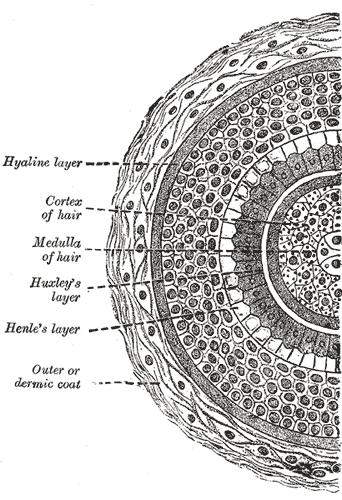
Credit: Henry Vandyke Carter · Public domain
Hair is a thin, flexible strand that grows out of the skin in mammals. Humans have hair almost everywhere on their bodies, except on the palms, the soles of the feet, and the lips. Hair is made of a tough protein called keratin. Keratin is the same material that makes up your fingernails and the claws, hooves, and horns of other animals.
Each hair grows out of a tiny pocket in your skin called a follicle. At the bottom of the follicle, living cells divide and push older cells up. As those older cells get pushed away from the blood supply, they die and harden into keratin. So the hair you can see and touch is not alive. That is why a haircut does not hurt.
A grown-up has about 100,000 hairs on their head. Each hair grows about half an inch a month. That adds up to roughly six inches a year. Hair grows for a few years, then rests, then falls out so a new hair can take its place. Most people lose between 50 and 100 hairs from their head every day, which sounds like a lot until you remember the total count.
Hair color comes from a pigment called melanin, made by special cells inside the follicle. More melanin makes hair darker. Less makes it lighter. As people get older, the cells that make melanin slowly stop working. New hairs grow in without color, and we see them as gray or white.
Whether your hair is straight, wavy, or curly depends mostly on the shape of the follicle. Round follicles grow straight hair. Oval follicles grow wavy hair. Flat, hooked follicles grow tightly curled hair. Your genes decide which kind you have.
Hair is not just for looks. Eyebrows keep sweat out of your eyes. Eyelashes catch dust before it reaches your eyes. The fine hairs inside your nose trap dirt before you breathe it in. The hair on your head keeps your scalp warm and shields it from the sun. When you get cold or scared, tiny muscles pull each hair upright, making goosebumps. In furry animals, this fluffs up the coat and traps warm air. In humans, it does not do much anymore, but the reflex stuck around from our furrier ancestors.
Scientists can learn a lot from a single hair. A hair holds a record of the chemicals in a person's body and even traces of their DNA. Detectives use hair as evidence in crime cases.
Last updated 2026-04-25