
Stephen Hawking
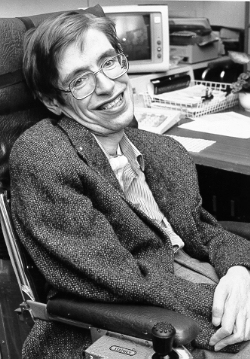
Credit: NASA · Public domain
Stephen Hawking was a British scientist who studied the universe, especially black holes. He lived from 1942 to 2018. Many people think of him as one of the greatest scientists since Albert Einstein. He was famous for his ideas about space and time, and for sharing those ideas with everyday readers in his bestselling book, A Brief History of Time.
Hawking was born in Oxford, England, exactly 300 years after the death of Galileo. He liked that fact and often pointed it out. As a kid, he was curious about how things worked, but he was not the top student in his class. He went to college at Oxford and then started studying the universe at Cambridge.
When Hawking was 21, doctors told him he had a disease called ALS, which slowly destroys the nerves that control muscles. They said he probably had only a few years to live. Hawking lived for 55 more years. The disease left him unable to walk, move his arms, or speak with his own voice. He used a wheelchair and a special computer that turned tiny cheek movements into spoken words. The robotic voice it made became one of the most famous voices in the world.
Hawking's biggest discovery was about black holes. A black hole is a place in space where gravity is so strong that not even light can escape. Most scientists thought black holes only swallowed things. In 1974, Hawking showed that black holes also leak a tiny bit of energy back out into space. Over a very long time, this slow leak can make a black hole shrink and disappear. Scientists call this leaked energy "Hawking radiation."
He also worked on huge questions about the start of everything. He helped show that the universe likely began at a single point during the Big Bang, almost 14 billion years ago. That is so long ago that Earth itself, at 4.5 billion years old, is not even a third that age.
Hawking wanted regular people, not just scientists, to care about the universe. A Brief History of Time, published in 1988, sold more than 10 million copies. He appeared on television shows like The Simpsons and Star Trek, often playing himself. He won many awards, but he never won a Nobel Prize. Hawking radiation has not yet been observed in nature, and the Nobel committee usually waits for proof.
He died on March 14, 2018. That was Pi Day, and also Albert Einstein's birthday.
Related
Last updated 2026-04-26