
Napoleon Bonaparte
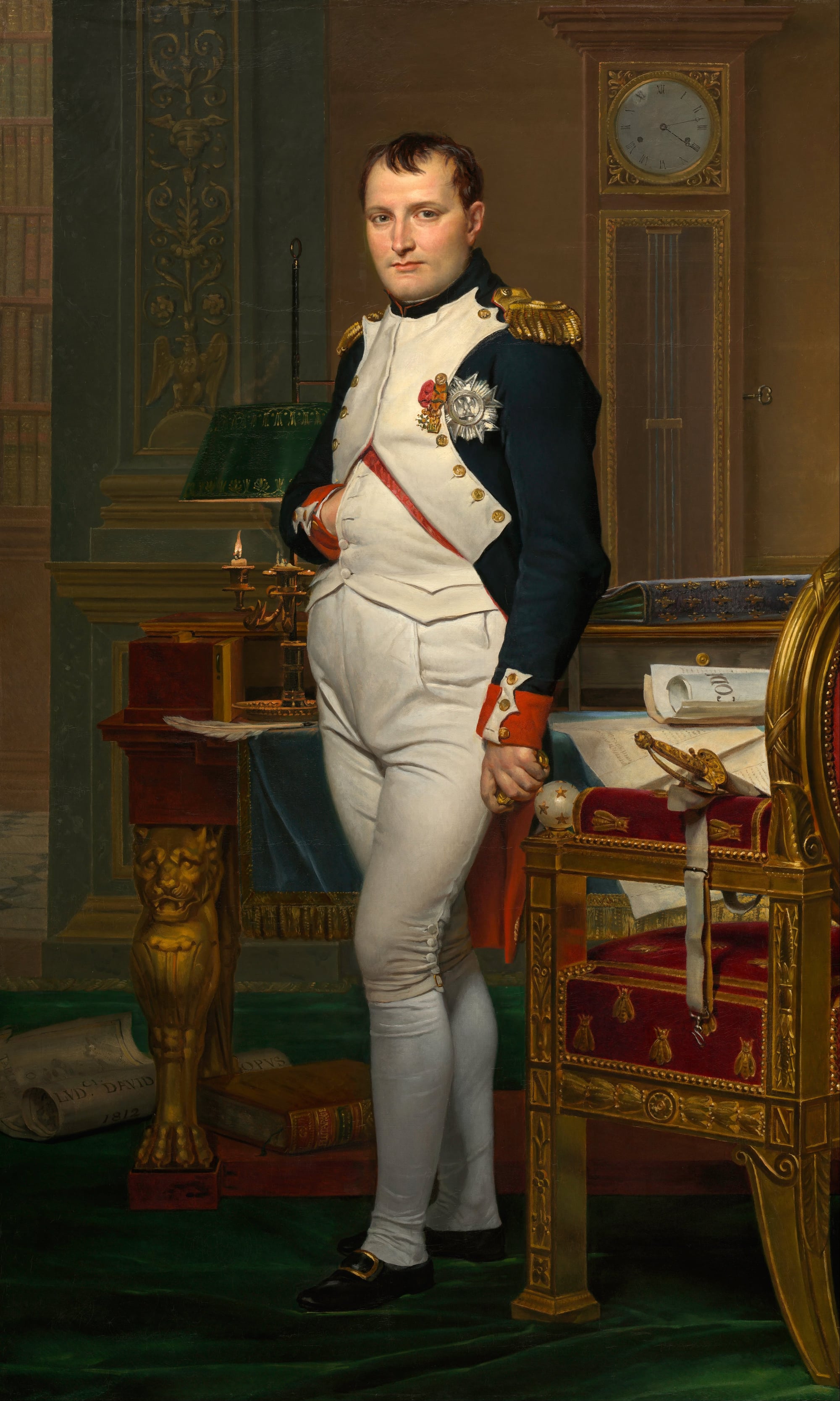
Credit: Jacques-Louis David · Public domain
Napoleon Bonaparte was a French general who became the emperor of France in the early 1800s. He lived from 1769 to 1821. He led France through a long series of wars, conquered much of Europe, and changed how many countries are governed even today. Few people in history have shaped the world as quickly as he did.
Napoleon was born on the island of Corsica, just after France took control of it. His family was not rich, but they sent him to military school in France when he was nine years old. He was a quiet, serious student who loved math and history. He spoke French with an Italian accent his whole life.
He rose to power during the French Revolution. The revolution began in 1789, when the French people overthrew their king. The years that followed were chaotic. France was at war with most of Europe. Napoleon, still in his twenties, won battle after battle for the French army. By 1799, he was popular enough to seize control of the government. In 1804, he crowned himself emperor in a grand ceremony in Paris.
As emperor, Napoleon did more than fight wars. He created a new set of laws called the Napoleonic Code. The code said that all male citizens were equal before the law, that no one could be jailed without a fair trial, and that religion was a private matter. Many countries later copied parts of the code. Modern French law still rests on it.
His armies marched across Europe. At his peak, around 1812, Napoleon controlled or allied with land stretching from Spain to Poland. Then he made a famous mistake. He invaded Russia with about 600,000 soldiers. The Russian winter and a long retreat destroyed his army. Fewer than 100,000 men made it home. Other countries saw their chance and joined together against him.
In 1814, Napoleon was defeated and sent to the small island of Elba. He escaped the next year and returned to power for 100 days. His final battle came at Waterloo, in what is now Belgium, in June 1815. British and Prussian armies crushed his forces. This time the British exiled him to Saint Helena, a tiny island far out in the South Atlantic. He died there in 1821.
Historians still argue about Napoleon. Was he a hero who spread the ideas of the revolution, or a dictator whose wars killed millions? Both views have strong evidence. What is certain is that the borders, laws, and even the school systems of modern Europe were shaped by the choices of one short, ambitious soldier from Corsica.
Related
Last updated 2026-04-26