
Passenger Pigeon
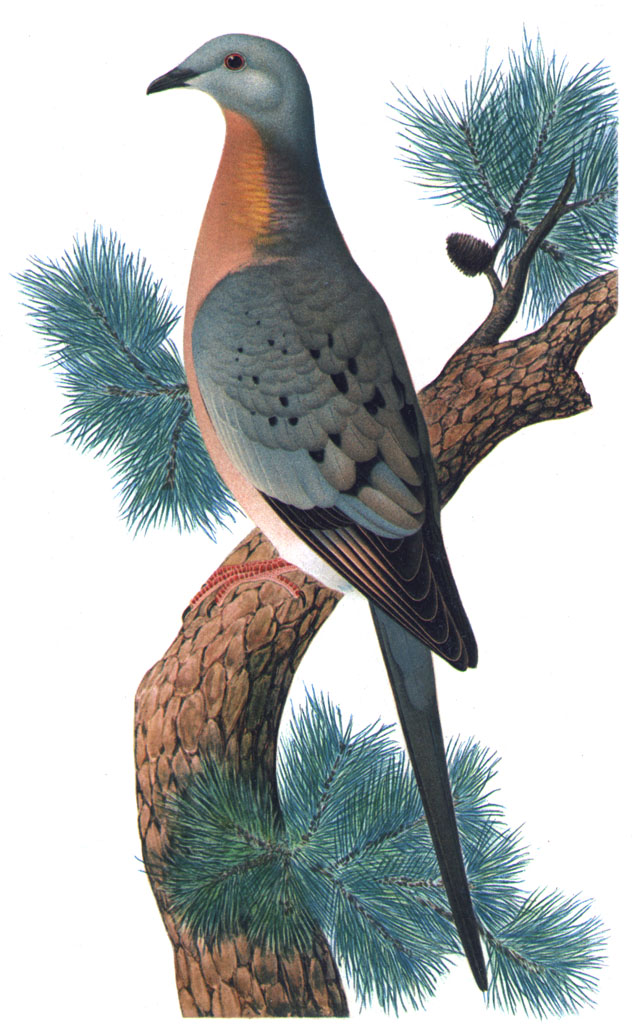
Credit: K. Hayashi · Public domain
The passenger pigeon was a wild bird that once lived in huge numbers across eastern North America. It looked a little like the city pigeons you see today, but slimmer, with a long pointed tail, a gray-blue back, and a soft red-orange chest. Adults were about 15 inches long. The bird was called "passenger" from a French word meaning "passing by," because giant flocks were always on the move.
For a long time, the passenger pigeon may have been the most common bird on Earth. In the early 1800s, scientists think there were between three and five billion of them. That is more than all the robins, sparrows, and starlings in North America today combined. A single flock could contain hundreds of millions of birds.
People who saw these flocks tried to describe them and often gave up. The sky would turn dark as if a storm were coming. The beating of wings sounded like thunder. In 1813, a naturalist named John James Audubon watched a flock in Kentucky pass overhead for three full days. He said the droppings fell like snow.
Passenger pigeons ate acorns, beechnuts, chestnuts, and berries from the huge forests that once covered the eastern United States. They nested in enormous groups. One nesting colony in Wisconsin in 1871 covered 850 square miles, an area bigger than many cities. Branches sometimes snapped under the weight of so many birds.
Then, in less than 50 years, they were gone. How could billions of birds disappear so fast? Two things happened at once. Settlers cut down the eastern forests, which destroyed the pigeons' food and nesting sites. At the same time, hunters killed the birds by the millions. Trains carried cheap pigeon meat to city markets. Telegraph lines let hunters send word of new nesting spots, so shooters arrived in days.
The birds also had a weakness scientists did not understand at the time. Passenger pigeons needed gigantic flocks to breed well. Once their numbers dropped, the small groups left behind could not recover. The last big nesting was in 1878. The last wild bird was shot in 1901. A female named Martha, the very last passenger pigeon alive, died at the Cincinnati Zoo on September 1, 1914.
Martha is now on display at the Smithsonian Museum. Her story helped change the way Americans think about wildlife. She is one reason the United States began passing laws to protect birds, and one reason the word "extinction" feels so heavy today.
Related
Last updated 2026-04-22